





Summary:
Lisa Proctor lives in an entirely black and white world.
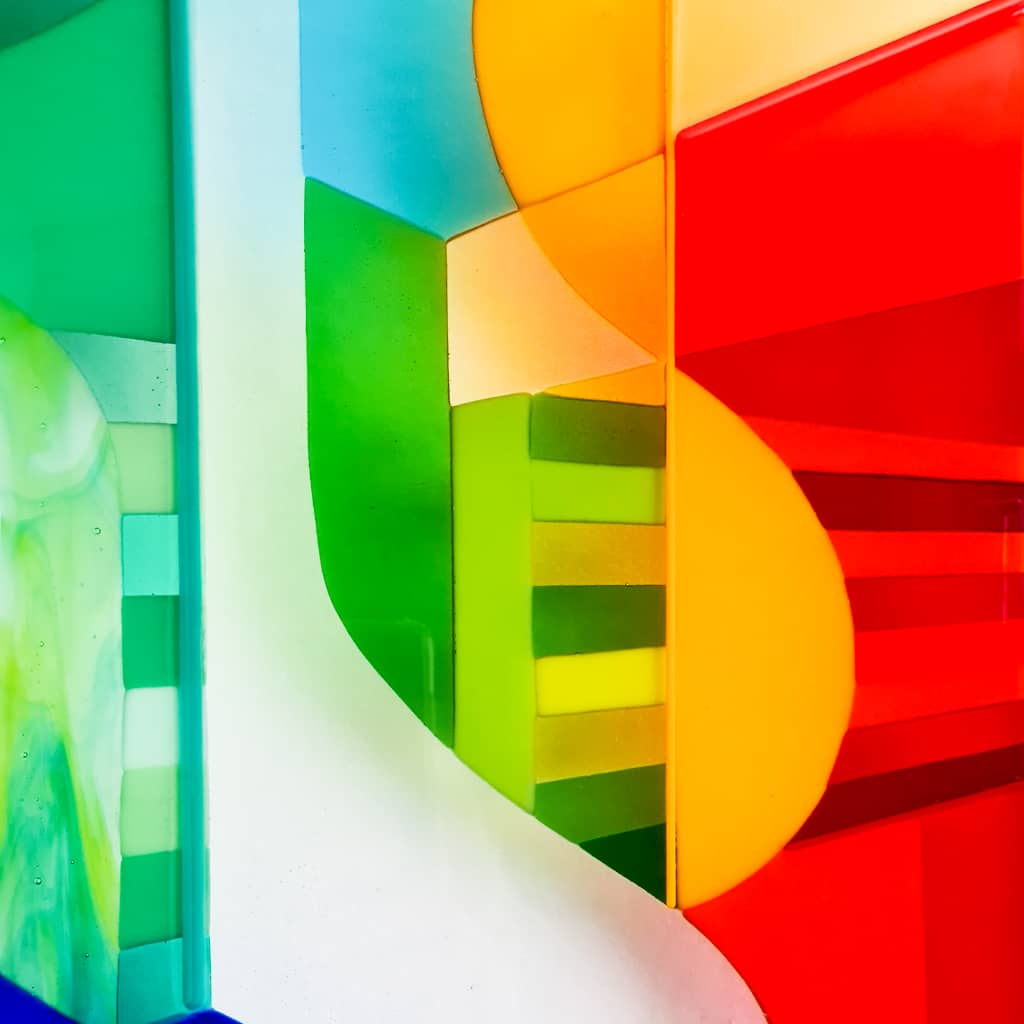
Yet she found herself repeatedly drawn to Linda’s brilliantly colourful glass.
Instead of changing her world to accommodate the art, she challenged Linda to enter hers.
The result was Mono Lisa, an unusually personal collaboration.
The production was also followed by thousands of people online.
Lisa Proctor had created an entirely black and white world.
Then she asked an artist famous for brilliant colour to enter it.
What followed became an online event and produced an artwork unlike anything Linda had made before.
Everything in Lisa Proctor’s home has a reason for being there.
The rooms are sleek, modern and unmistakably black and white.
The kitchen is black and white.
So are the pots, pans, cups, plates and even the forks.

Her cars were black for years. Now they’re white.
At one point, Lisa introduced a little red into a guest bedroom and bathroom. It was a concession to people who teased her about everything being monochrome.
Then she changed her mind.
“I said, you know what? No more red. I’m going with what I want. It’s my house.”
That one comment tells you a great deal about Lisa.
She knows what she likes and has no interest in filling her home with things merely because other people consider them normal.
Friends describe the house as having something of a glamorous Miami nightclub about it.
Lisa prefers:
“Modern, sleek and clean.”
What she puts on her walls is art.

Sometimes she buys it. Sometimes, if she can see something in her mind but cannot find it anywhere, she makes it herself.
“If I can see something in my head and I can’t find it, I’ll paint it or make it myself and put it in that space.”
This was the world into which Linda’s brilliantly coloured Hard Edge glass art unexpectedly arrived.
The artist who nearly made Lisa break her rule
Lisa first began seeing Linda’s work on Facebook.
She noticed the intensity of the colour and how different the pieces looked from other glass art she had encountered.
“I kept seeing all this beautiful, colourful glass art. It was different from other glass pieces that I’d seen.”

Then she saw one of Linda’s face designs.
“I was like, oh my God, look at this. This is gorgeous.”
Lisa continued looking.
The colours should not have belonged in her world. Yet every piece seemed to create the same immediate reaction.
“The colours were so vibrant and they mixed well together. You can put colours together, but for some reason they may not always pop. Every single piece I looked at popped.”
It was not only visual admiration.
“It made me feel happy for some reason. It was just so beautiful.”
Lisa liked Linda’s way of showing the work being made too. She watched the glass being cut and followed the pieces as they travelled towards the kiln.
She also noticed Linda’s reaction whenever a completed artwork emerged.
“You would hold it up from the kiln and smile. I was like, look at her smile! It’s so cute.”

There was joy in the art and joy in its making.
Lisa eventually visited Linda’s website and discovered that the artworks could be commissioned.
That created a problem.
“I thought, it’s so vibrant and colourful. She probably won’t do black and white.”
Lisa loved the work so much that she considered breaking her own rule.
“I seriously thought it might be the one colourful piece. If she doesn’t do black and white, I may have to break my rule.”
Before surrendering, she decided to ask.
Would Linda create something entirely in black, white and grey?
Linda had never done it before. But she was willing to try.
“That’s where my excitement really started. You said, I’m always open for a challenge. I thought, that’s what I like to hear. Challenge accepted. Let’s move forward.”
Two people who dislike the ordinary
Lisa is drawn to people willing to move beyond what they have already done.
She applies the same test when choosing contractors for her home.
“Are you willing to go beyond the norm? Whether you’ve done it before or not, I want you to push yourself and try it.”

One answer brings the conversation to a quick end.
“If somebody says, well, most people do this, that’s when you’re out of my house. I don’t care what most people do.”
Linda understood the challenge differently.
Her art may be celebrated for its brilliant colour, but its underlying language is built from line and shape. The visible subject gives those relationships somewhere to happen.
Black, white and grey offered another palette.
They could still create contrast, rhythm, balance and movement. The question was whether Linda could preserve the light and energy of her work while using them.
Lisa wanted something Linda had never made.
Linda wanted to discover whether she could make it.
The two personalities suited one another rather well.
Finding Lisa in the design
Lisa did not arrive with a finished picture and ask Linda to reproduce it.
She sent photographs of her home and described what she liked.
The face was important.
“I love the weirdness and abnormalities of Picasso. Everything doesn’t have to be matchy matchy match.”
Linda’s flowers and birds were beautiful, Lisa said, but they belonged to somebody else’s world.
“They’re just not my style. I like the weirdness. I like things I know I’m not going to see when I walk into somebody else’s home.”
Linda prepared three initial face designs.
Lisa chose elements from each, removed what she didn't like, and asked for more geometry in particular areas.
“You sent me the first three drafts and I liked a little from this, a little from that and a little from the other.”
The design developed through conversation. By the third version, Lisa knew.
“I was one thousand percent, yes. This is it.”

Lisa had commissioned special pieces from artists before. What made this experience different was her involvement in shaping the result.
“Yours was the first I truly created with the artist.”
She did not need to understand kilns or how individual pieces of glass would behave.
She contributed her eye, her home, her reactions and her sense of herself.
Linda turned those things into art.
“I felt I truly helped design something for my home, for what I like and for what I saw in my head.”
A commission followed by tens of thousands of people
As Linda sent photographs and videos showing the artwork developing, Lisa shared them online, as did Linda.
Thousands of people began following the project. This grew and grew.

They watched the design take shape. They saw glass being selected, cut and arranged.
They waited to discover what would happen when Linda’s famously colourful visual language entered Lisa’s monochrome world.
The audience eventually became involved in one important decision.
The artwork needed a title.
Suggestions were gathered and a public poll was held.
The winning name was: Mono Lisa
It is difficult to imagine a title that could fit the artwork or its owner more perfectly.

Some commissions remain completely private. The commissioner may be planning a surprise or simply prefer to keep something personal away from public view.
Lisa was the opposite.
Sharing the adventure was part of her enjoyment.
Every commissioner is different. So is every journey towards the finished glass.
Video showing the final Mono Lisa artwork
The real challenge was light
Removing bright colour was not Lisa’s principal concern.
Light was.
“The only thing that worried me was, would the light still come through it?”
She did not want an artwork dominated by heavy black glass or flat, opaque greys.
It needed to remain luminous.
“I think I stressed it quite a few times. I still want the light to come through. I want the light to come through.”
Black had to provide strength without overwhelming everything around it. The whites and greys needed variation. Transparent glass had to keep the composition open and alive.

Throughout production, Linda sent photographs and videos of the actual glass held against the light.
“When you sent me pictures of the glass and videos holding it up, I thought, yes. I feel comfortable that the light is going to come through.”
Nothing disappeared behind the workshop door.
Lisa could see what Linda was seeing. The glass was transparent.
The working method was transparent too.
“There was no tension of, oh, she’s not getting what I want. It was delightful and easy.”
When Mono Lisa finally reached its home, daylight completed the work.
“When I open my blinds, the light shines through it in different ways. I just love it.”
Giving the music its own place
Lisa also wanted to incorporate a Spotify code connected to a piece of music.
Linda felt that placing the code inside the main roundel would weaken the composition.
She suggested creating a smaller artwork to accompany Mono Lisa.
“I loved the fact that you suggested a second piece because the code really wouldn’t have looked good on the main piece.”

The two artworks would be different in shape, yet belong together.
“That made it a little different, but they still collectively go together.”
Lisa’s first choice of music was energetic. As Mono Lisa developed, she realised that the artwork asked for something calmer.
“This piece wasn’t speaking that to me. It was more about marvelling at it and relaxing while looking at it.”
Glass, changing light and music now formed a single experience.
The Mono Lisa party
When Mono Lisa arrived, Lisa did not merely put it on display.
She held a party.
Lisa is one of eight siblings and her home is the natural gathering place for family events, monthly get togethers and game days.
“Everything is always at my house. I’m the hostess with the mostest, as they say.”
Her family had heard about Mono Lisa throughout its creation.
“My family was so sick of me saying, wait until you see Mono Lisa. Wait until you meet her.”
At the party, Lisa told everyone to have their phones ready.

They gathered around the glass, scanned the Spotify code and brought the music into the unveiling.
“They loved it. A lot of them had never seen anything like that added to a piece of art.”
Then came the response that mattered most.
“They said, that is so you.”
The people who knew Lisa best recognised her in the artwork.
Her black and white world. Her unconventional eye. Her confidence. Her refusal to accept anything ordinary.
“Everybody was amazed at how marvellously it went in my home. I said, I sent Linda pictures of my house and she nailed it.”
Holding the real glass
Before Mono Lisa could be celebrated, it had to travel safely to Lisa.
“My biggest fear was that it would get to me cracked or broken. I would have died because I had waited so long.”
Lisa filmed herself opening the parcel in case the artwork had been damaged. It arrived perfectly.
“It was so well packaged there wasn’t a chance anything would have broken.”
Then she held the real glass.

The photographs and videos had shown Lisa what it looked like. They could not reproduce its weight, surface and presence.
“The photos were beautiful, but actually holding it in my hand was just awe.”
Another feeling arrived with it.
Pride.
“I thought, oh my God, my very own commissioned, custom piece of real art. I felt so proud to own it.”
Lisa does not consider herself an artist, although she has created paintings and designs for her own home and previously ran a successful event planning company.
She knows what she likes. She can recognise when something is right. And during this commission, those abilities were taken seriously.
“You didn’t make me feel as though I didn’t know what I was doing. Whether I knew anything about that kind of art or not, it was my piece. You were customising it to me and working with me.”
Mono Lisa became more than another beautiful possession.
“It’s the piece I’m proudest of in my house.”
The story beside the artwork
Mono Lisa and its musical companion now stand at the centre of Lisa’s living room.
Beside them is Linda’s illustrated hardback book recording the project.

Lisa had expected something fairly simple.
“I thought it was going to be a little basic book, which would still have been fine.”
Instead, she received a substantial volume with carefully chosen photographs and beautiful paper.
“It reminded me of a book you would buy from an art gallery. It was just so well done.”
Linda designs every commission book herself. Each one preserves the ideas, decisions, photographs and making of an artwork that exists nowhere else.

The glass is made to endure.
Its book is created to remain with it, preserving the illustrated story of how it came into being.
For Lisa, it is proof that the whole experience really happened.
What Mono Lisa revealed
Mono Lisa was Linda’s first entirely black, white and grey Hard Edge artwork.
Yet it does not look like Linda’s usual work with its colour removed.
It has its own presence.

The commission revealed that Linda’s art does not depend upon flowers, animals, faces or any other particular subject.
Nor does it depend upon a familiar blaze of brilliant colour.
Its foundations lie in shape, contrast, composition and light.
“I was excited that this was your first black and white piece. It was outside your norm.”
Lisa had challenged Linda to enter an unfamiliar palette.
Linda preserved the visual strength of her Hard Edge language while creating something that could only belong in Lisa’s world.
Video showing the final Mono Lisa artwork
It was not a monochrome version of an existing artwork.
It was a unique original created through the meeting of two different imaginations.
“It was exactly what I had in my head. It was the most perfect artwork I have collaborated on and brought into my home.”
Lisa is already imagining another possibility.
Something tall.
Something structural.
Perhaps a three dimensional glass work for another part of the house.
Linda has begun imagining too.
One unprecedented idea has now opened the door to another.
Living with Mono Lisa
The online excitement has passed.
The party is over.
Mono Lisa now belongs to Lisa’s everyday life.
During the day, natural light passes through the black, white and grey glass.
At night, the spotlight creates a different atmosphere.
Sometimes Lisa makes herself a latte, turns on the spotlight and scans the Spotify code.
Then she sits down and looks.
“I take my phone, put the Spotify song on, switch the light on and just look at the piece.”
No audience.
No unveiling.
Just Lisa, the music and Mono Lisa glowing inside the black and white world that inspired it.
“Every day, I love it.”
Leave a comment
Hard Edge glass art blog
View all


ABOUT THE AUTHOR
“Hi, I’m Kevin, Linda’s lifelong soulmate. I’m a professional scriptwriter by trade, for which I’ve won many awards.
My mission is to bring Linda’s genius for colour & form into plain words everybody understands and enjoys.”
