



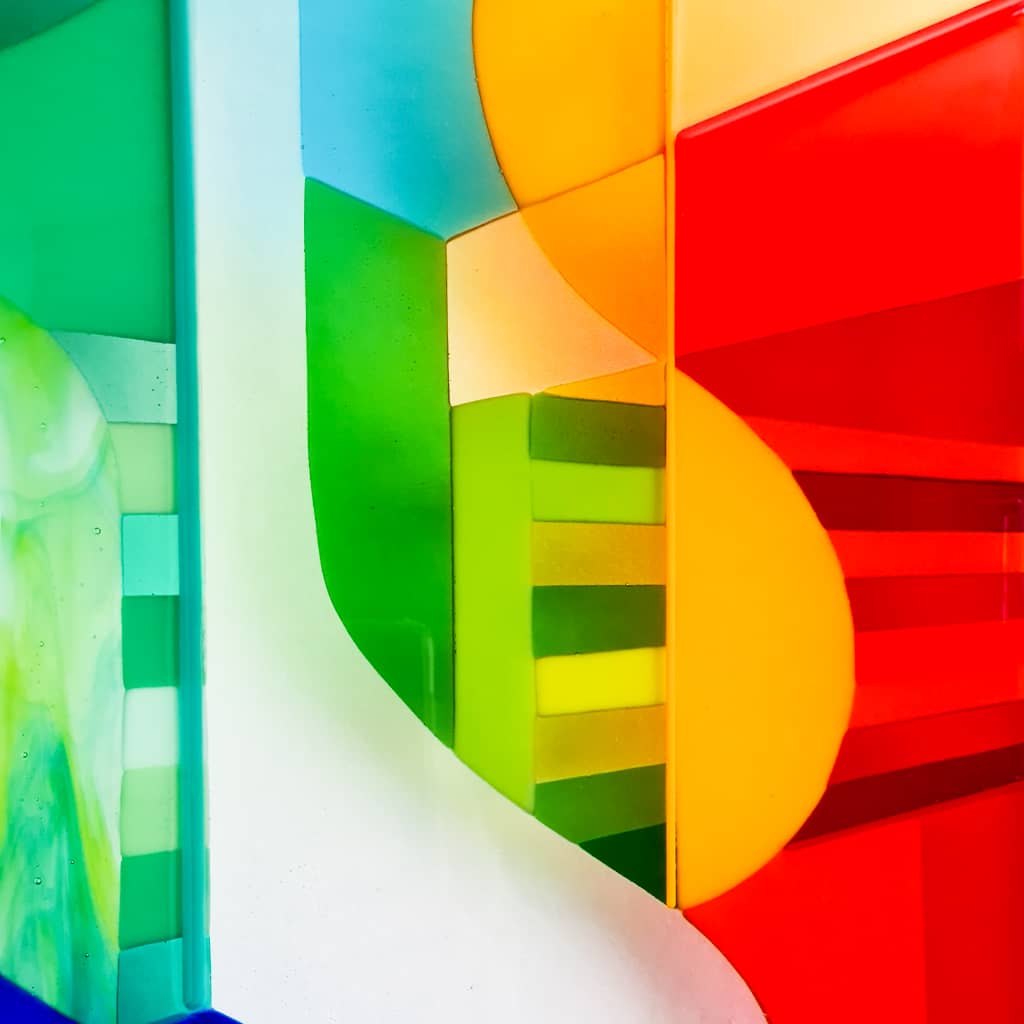


Rashmi Sinha is a glass artist and collector with a lifelong love of colour and light.
After several journeys through the Himalayas, she wanted an artwork that would bring back the landscapes and feelings she remembered.
The result was Shangri-La, a colourful interpretation of mountains, trees and flowers from her travels.
We talked about her love of glass, trusting another artist with her memories, and living with the finished artwork.
An interview with collector and glass artist Rashmi Sinha
How do you turn half a dozen journeys through the Himalayas into one artwork?
And what happens when a glass artist commissions another glass artist?
Rashmi Sinha has a lifelong fascination with glass. She makes stained glass herself, collects work by other glass artists, and has filled her home with different examples of the medium.
But her commission from Linda Rossiter was something particularly personal.
Rashmi had travelled through Kashmir, Nepal and Tibet, trekking through forests and mountain landscapes to altitudes of 18,500 feet. She wanted an artwork that would bring back not just the scenery, but the extraordinary feelings those journeys had inspired.
The result was Shangri-La, a colourful, imaginary Himalayan landscape combining memories from several different journeys.
We talked to Rashmi about her travels, her love of colour, her experience of commissioning Linda, and what it's like to live with the finished artwork.

A lifelong fascination with glass
Rashmi's love of glass began in Glasgow, inspired by Charles Rennie Mackintosh (1868–1928), one of the city's most celebrated creative figures. An architect and designer, he created the Glasgow School of Art building and helped define the Glasgow Style.
It was his glasswork that particularly caught Rashmi's imagination. Today, she makes stained glass herself and collects work made using several different techniques.
Linda: Where did your love of glass come from?
Rashmi: I think it's because I grew up in Glasgow, with all the Charles Rennie Mackintosh things, particularly the art school. There was some beautiful glass work that he'd done, as well as so much other work. I just really love his stuff.
Linda: And you make glass yourself?
Rashmi: Yes, I do stained glass, both lead and copper foil. It's a hobby rather than a business, although I make things for friends when they ask me.
Linda: What is it about working with glass that fascinates you?
Rashmi: I like light. I like the way light plays with glass.
I love mirrors, textured glass, different coloured glass, and the way the light comes through it. That's what really fascinates me.
I'm also a photographer, so I enjoy the light aspect of everything.

Linda: Does making glass yourself change how you look at other people's work, including mine?
Rashmi: Oh, definitely. That's why your work fascinated me. It's so precise.
I haven't done fused glass, but looking at your work, I can appreciate the amount of technique it needs. You're very, very skilled at what you do.
I'm not so precise myself! That's why stained glass is good for me. You can hide a little bit of imprecision in stained glass.
Linda: What first attracted you to my work?
Rashmi: The lines were so distinct and the colours were so bright and beautiful.
I'd seen some of your flowers, your botanic gardens and some of your other work. I really liked it.
Then I started thinking, well, what would I want to have? And that's when I thought about my theme.

The mountains, the memories and the idea
Rashmi had made around half a dozen trekking trips in the Himalayas. What stayed with her most wasn't any one particular view, but the immense scale of the landscape and the almost spiritual experience of being there.
Linda: Tell me about your travels in the Himalayas.
Rashmi: Over the years I've been several times. I've been to Kashmir, Nepal and Tibet. I've done maybe half a dozen trips trekking in the mountains.
I was born in India and lived there until I was twelve. Then I grew up in Glasgow, and I came to America to do my PhD when I was about twenty-five.
I actually did most of my trekking while I was living in Britain, although I went to Tibet from the US.

Rashmi made around half a dozen trekking journeys through the Himalayas, drawn back by the immense scale of the mountains and the extraordinary feeling of being there
Linda: What was it about those mountains that kept drawing you back?
Rashmi: The mountains have this spectacular feeling about them. It's like you feel close to God. There's something spiritual about it.
Maybe it's become quite busy now, but when I went, it was pretty quiet. There's a special communion you have with nature there.
That's what I really liked.
Linda: When you think back to those journeys, is it the scale, the colours or the physical experience that you remember most?
Rashmi: I think it's the scale, and more of an emotional, spiritual feeling.
You feel very insignificant in those huge, magnificent vistas.
Linda: So what did you want your finished artwork to make you feel?
Rashmi: I wanted the memories of the mountains, and the feelings, to come back.
To be able to look at it and have it take me back to some of my journeys.
Linda: How clearly did you imagine the picture when you first contacted me?
Rashmi: I knew I wanted a range of mountains, and I wanted trees.
When you're trekking in the Himalayas, you go through so many different landscapes. I started at zero altitude and went up to about 18,500 feet, so you go through all these different kinds of vegetation.
At around 8,000 or 10,000 feet, or maybe 12,000, you'd have conifer trees. Further down there were flowers, including the rhododendrons.
I wanted a mixture of all these different things within the picture.
And you captured it very well.
Linda: Does Shangri-La represent somewhere you actually visited, or is it a mixture of places?
Rashmi: It's more a mixture of everything.
It's not one particular place, because all those things happen at different altitudes.
It's more like a collage of the journey.

Rashmi's memories of different Himalayan landscapes gradually coming together as hundreds of individually cut pieces of glass are fitted into place
Colour, artistic freedom and trust
Although Rashmi had a clear idea of the landscape she wanted, she deliberately gave Linda considerable freedom to interpret it. Having commissioned art before, she believes that trusting an artist is part of the experience.
Linda: You were quite definite about wanting vivid colours. Why is that?
Rashmi: I don't know! I've just always liked vivid colours. Maybe it's my Indian upbringing. We have a lot of colour in India, and I think that's stayed with me.
I'm not really into muted colours. I love bright colours, and that was one of the things that attracted me to your work in the first place.
Linda: Because you work with glass yourself, did you enjoy seeing the different glass choices as Shangri-La developed?
Rashmi: Yes, I did. We didn't actually have too much back and forth over the glass, because I generally liked what you'd chosen.
The main decision I remember was whether to have grey mountains or blue mountains. I think I went with the blue. Other than that, I was happy to let you do the choosing.


Linda: Was it easy to hand those decisions over to somebody else?
Rashmi: Yes. I came to you as an artist to develop something.
You have to trust the artist. Otherwise, why would you go to them?
I trusted your take on the whole situation.
Linda: Have you commissioned other artwork before?
Rashmi: Yes, I have three mosaic pieces in my living room, made by a young local artist.
I gave her a broad idea of what I wanted. One was to use mirrors, another red, orange and yellow, and the third blue, green and purple.
Then I just let her design them.
I think that's a nice way of doing it.

Linda: And what did you think of the name Shangri-La?
Rashmi: I thought it worked very well.
Shangri-La is this imaginary world of perfection, somewhere up in the Himalayas.
So it seemed right for what we were creating.

Living with Shangri-La
Shangri-La now hangs on Rashmi's wall, where daylight and an adjustable light bring out its colours and textures. What catches her eye varies, too: sometimes the flowers, sometimes the mountains or clouds. She finds something different to enjoy depending on her mood.
Linda: What was your reaction when you finally saw Shangri-La?
Rashmi: Oh, I really loved it. I think it's great.
It's up on my wall, and I really enjoy looking at it all the time.
Linda: Was it different from what you'd expected from the photographs?
Rashmi: Not really, because your photographs were a very good representation. I knew what I was getting.
And the packaging was excellent. It arrived very securely.
I actually received another glass artwork a month or two later, from somebody else, and it was broken because it hadn't been packed properly. The artist had to make it again.
So I appreciated the care you'd taken.
Linda: When you look at Shangri-La now, what catches your eye first?
Rashmi: It's different at different times.
Sometimes it's the flowers, sometimes it's the mountains, sometimes it's the clouds.
It depends on my mood and what I get out of it that day.
Each time it can be different.

Linda: And how have you been lighting it?
Rashmi: It's on a wall opposite a window, so during the day it gets natural light coming across the room.
Of course, because it's against a wall, the light can't come through the glass. It's more about the reflections.
So I've put a light bar above it for the evenings, to bring out the different textures and reflections.
The light has three different warmth settings, so I can change the way the artwork looks.
I enjoy playing around with that.

A home that's become a glass museum
Shangri-La isn't Rashmi's only glass artwork. Her collection includes sculpture, mosaics, fused glass and her own stained glass. She enjoys seeing what different artists can achieve with the same extraordinary material.
Linda: Does Shangri-La fit in with the other glass artworks in your room?
Rashmi: Oh, yes, because they're all different kinds of glass.
I have a big glass sculpture above my fireplace that gives wonderful reflections when the light shines on it.
Then I have my three mosaic pieces, your fused glass artwork, and another fused glass piece that's more abstract.
And I'm making a stained glass window myself.
It's like a glass museum! I've got all these different kinds of glass.
That's what I enjoy, seeing the different techniques.

Linda: What's the stained glass piece you're making at the moment?
Rashmi: Mine is more abstract.
It's going into a window, and I'm using clear glass with lots of different textures.
There's already so much colour in the room that I wanted this piece to be colourless, so you notice the patterns and textures in the glass.
It's nearly finished. I just have to solder it and patina it.
Linda: Do you think you'll ever try kiln-fused glass yourself?
Rashmi: I'd like to. I think in another year or two I might take some classes in fused glass, and perhaps mosaics as well.
The trouble is, it's such an expensive hobby. I've already bought all the equipment for stained glass, and fused glass would mean buying a kiln and everything else.
And I don't like making small things. I like making big things!
So I'd need a pretty big kiln.

An unexpected little gift
Linda included a small fused-glass colour bar featuring the artwork's palette. We were curious whether Rashmi regarded hers simply as a record of Shangri-La's colours, or as something more.
Linda: Did you like the colour bar that came with Shangri-La?
Rashmi: I love the colour bar!
It's in my studio now, right in the window. I have it there as a showpiece.
Linda: Kevin wondered whether you see it as a record of Shangri-La's colour palette, or as an artwork in its own right.
Rashmi: I think it's a piece in its own right.
I just love it. I wish I could put it into one of my stained glass pieces.
Linda: That's interesting, because it's actually why I started fusing glass in the first place. I thought I'd make little fused pieces to put into stained glass.
But once I started fusing, I realised that was what I really wanted to do!

Looking back on the experience
Rashmi describes commissioning Shangri-La as an easy and enjoyable collaboration. For her, the pleasure came from seeing the artwork develop while giving Linda the freedom to make the artistic decisions.
Linda: Looking back, did you enjoy the collaboration?
Rashmi: Very much so.
I liked seeing the progress and the things you sent me along the way.
It was very easy and very enjoyable. I didn't have any problems with it at all.
Everything went very nicely. No unwanted surprises.

An unexpected encounter on the Isle of Mull
Towards the end of our conversation, Rashmi remembered a small encounter during a visit to Scotland that had amused her.
Rashmi: Oh, I wanted to tell you something!
I was on the Isle of Mull, in Tobermory, and there was a little shop with some fused glass in the back.
I went in to have a look around, and I got talking to the woman there.
I mentioned that I was getting some glass artwork from Linda.
And she said, "Oh, Linda, she's amazing!"
She knew all about your work and was going on about how good it was.
So your name is everywhere!
Linda: That's absolutely brilliant. Thank you for telling me!
The eye of a fellow glass artist
Rashmi brings an unusual perspective to commissioning art.
She doesn't simply collect glass: she makes it, and she's curious about the different things artists can achieve with it.
Her home contains stained glass, mosaics, sculpture and fused glass, each chosen for qualities she appreciates.
That practical knowledge shapes her response to Linda's work.
She noticed the precise lines and vivid colours immediately, and recognised the skill required to achieve them.
She knew what she wanted Shangri-La to evoke, but was content to leave many of the artistic decisions to Linda. Her trust came from knowing what she was looking at.
And perhaps the most revealing detail is the smallest.
Rashmi has displayed the accompanying colour bar in her studio window. To her, it's not merely a record of the colours in Shangri-La. It's another artwork worth enjoying in its own right.
Leave a comment
Collector Interviews
View all


ABOUT THE AUTHOR
Linda Rossiter is a British contemporary glass artist and pioneer of the Hard Edge glass art style. She creates original fused glass artworks from her Lancashire studio for collectors worldwide, combining a lifelong fascination with colour, geometry and precision with the way glass interacts with light.
Through her writing, Linda shares the ideas, stories and processes behind her work.
