



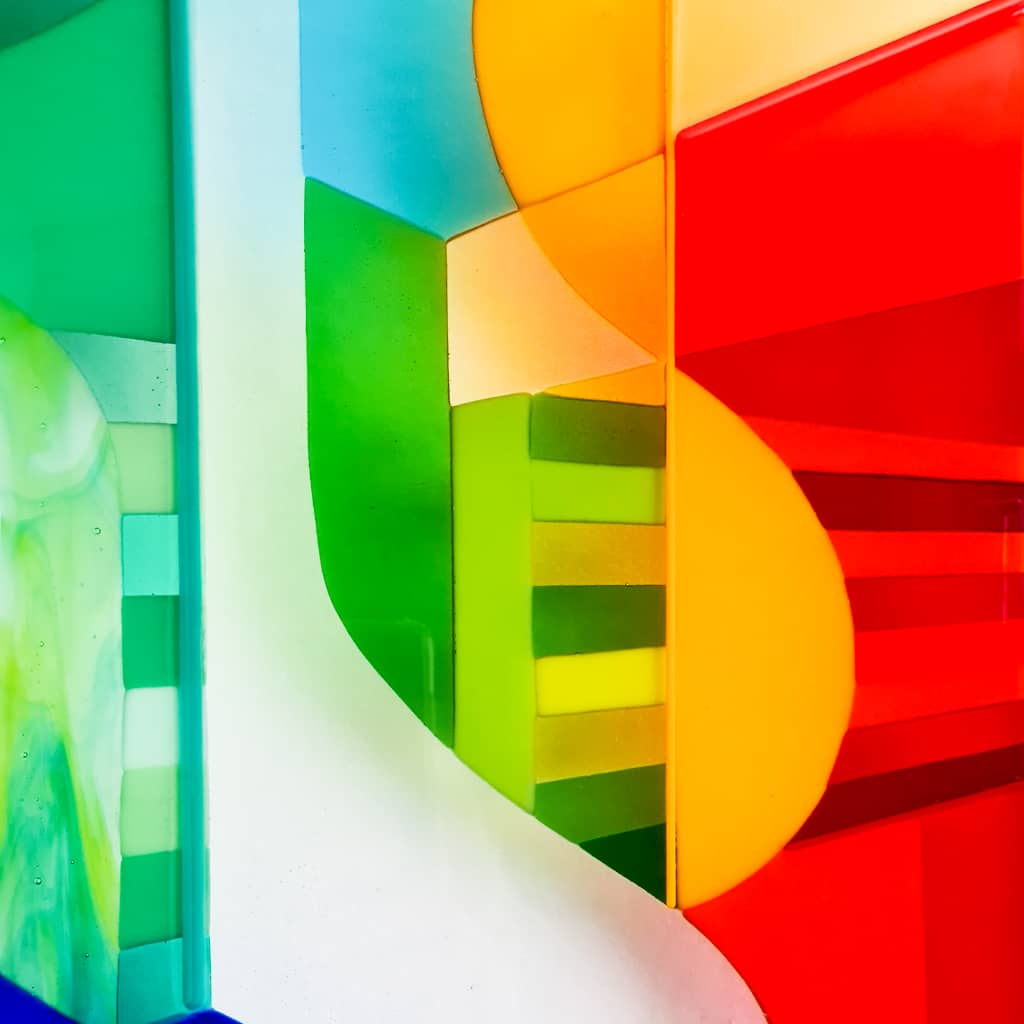


Living Light: 10 ways to keep discovering your glass art
One of the pleasures of owning glass art is that it doesn’t stay visually fixed.
Daylight changes it.
Evening changes it.
Move a light a few inches, soften it, brighten it, or place the artwork somewhere different and you can suddenly notice something you hadn’t seen before.
It’s what we call Living Light.
It’s one of the extra pleasures that continue long after a commission is finished.
Once the artwork's arrived, it’s yours.
But the discovery has only just begun.


Glass gives you room to play
A painting on a wall will often have one lighting position that works particularly well.
Glass is rather more playful.
Light can pass through it, bounce off it, create shadows behind it, brighten one colour while softening another, or even completely alter the mood of the work.
You can make the same piece feel dramatic one evening and much softer the next.
And you don’t need specialist art lighting to do it.
Every full commission comes with a small USB powered spotlight to get you started. There’s no installer required and no art lighting expertise to learn.
Try putting it somewhere near your artwork.
Angle it.
Dim it.
Move it.
See what happens. See if you like it.
If you enjoy experimenting, you can easily add a second small USB light, or try other portable lights you already have around the house.
There really isn’t a correct answer.
What matters is how the artwork looks to you in your home.
Do you need special lighting for glass art?
No.
Good specialist lighting can obviously be useful, particularly for large installations, but it isn’t necessary for enjoying glass art at home.
A small portable light can make a surprisingly big difference.
Hard Edge glass responds particularly well because the crisp shapes, transparent and opaque glass, strong colour contrasts and reflections all react differently as the light changes.
Here are ten easy ways to experiment.

1: MOVE THE SPOTLIGHT AROUND
Try your spotlight from different angles.
Front, side and lower positions can all create different reflections and shadows.
Even a small movement can change the way the piece looks.
Try lighting from beneath. Then move the light slightly to one side.
You may find a completely different version of the same artwork.
This is probably the simplest introduction to Living Light.


2: DIM THE LIGHT, THEN BRIGHTEN IT
A dimmer gives you another easy way to change the mood.
A softer light can make an artwork feel subtler and more atmospheric.
Turn up the brightness and colours can suddenly become much more dramatic.
Try gradually dimming the light while looking at the artwork.
There’s often a point where something unexpected happens.
A particular colour comes forward.
A reflection appears.
A shadow suddenly becomes part of the composition.
3: ADD A SECOND SPOTLIGHT
One light gives you plenty to experiment with.
Two open up another set of possibilities.
Place them at different angles and you can create several highlights, overlapping shadows and different areas of emphasis.
Move them independently.
Try one low and one to the side.
Try making one brighter than the other.
Or use different colour temperatures.
Small USB powered lights are portable, so there’s no need to commit to a permanent lighting arrangement.
Play until something makes you stop and look.


4: TRY A STRIP LIGHT
A USB strip light gives a different effect again.
Instead of a concentrated spotlight, you get a broader and more even wash of light.
A warmer strip light can create a gentle glow.
A cooler light can make edges and detail feel sharper.
Place one below the artwork and see what happens.
Glass can have quite different personalities according to the type of light around it.
5: BORROW AN ANGLEPOISE LAMP
You may already own another useful piece of art lighting without realising it.
A desk lamp or floor standing Anglepoise style lamp can give you a softer fill light.
Try pointing it directly at the artwork.
Then try pointing it towards a nearby pale wall so the light bounces back more gently.
The difference can be considerable.
This is a good way to soften strong shadows if you want a quieter effect.


6: EXPERIMENT WITH REFLECTIONS
Glass doesn’t only respond to the light shining directly onto it.
It also responds to the room around it.
Try placing a freestanding piece near a mirror, pale wall, glass tabletop or another reflective surface.
The reflected light can add depth and make colours appear in unexpected places.
If you have a glass table, try lighting a piece from below.
You can get a lovely floating effect.
Sometimes the reflection becomes almost a second artwork.


7: WALL MOUNTED GLASS? YOU CAN STILL PLAY
A wall mounted artwork doesn’t stop Living Light.
Place a small spotlight on a nearby table or shelf and direct it upwards or sideways.
Move the light rather than the artwork.
Natural daylight will be doing its own work at the same time, changing through the day and through the seasons.
Of course, you can move the artwork too.
That takes a little more commitment because a wall mounted piece normally means another fixing in the wall.
But if you’re comfortable with DIY, trying a completely different wall can make a familiar artwork feel surprisingly new.
There’s no rule saying art has to stay in the same place for twenty years.

8: PLAY WITH COLOURED LIGHT
Some small lights give you a choice of warm white, cool white or colour.
They can be great fun with glass.
Try a warm light one evening and a cooler one another time.
Or use colour occasionally for a deliberately dramatic effect.
Different coloured light will interact with the colours already inside the glass, sometimes in ways you won’t predict.
You may love the result.
You may hate it.
Change it back.
That’s the beauty of experimenting.
Nothing has been spoiled and nothing has been done incorrectly.
See Living Light in action
9: MIX IN NATURAL ELEMENTS
Glass and plants can be great companions.
Try placing a freestanding piece among or near green houseplants, then light it from behind or beneath.
The contrast between organic leaves and the precise geometry of Hard Edge glass can be striking.
Warm light can create something quite lush.
Cooler light gives a completely different atmosphere.
And of course the plants themselves change and grow.
Living Light doesn’t always have to involve the glass changing on its own.
Sometimes it’s the surroundings that make you see it differently.


10: CHANGE THINGS AROUND
Don’t assume that because you’ve found a good position for your artwork, it has to stay there forever.
A freestanding piece is particularly easy to move.
Try another room.
Another table.
Another direction of daylight.
Move it from somewhere you normally see while sitting down to somewhere you pass several times a day.
We recently moved Toucans, one of our own favourite pieces, from its familiar position in the lounge to near the entrance to one of our studios.
The effect was brilliant.
It felt as though we were seeing the piece again.
Now it seems to give us a cheerful hello every time we go to work.
Same artwork.
Completely different relationship with it.
That’s Living Light too.
When’s a good time to experiment?
Any time.
But evenings are particularly good because you have more control over the light.
Late winter afternoons can be interesting as daylight gradually disappears.
Changing seasons are another excuse.
So is moving furniture.
So is having people round.
And sometimes there’s no reason at all.
You simply look at the artwork and think:
"I wonder what happens if I put the light over there?"
Try it.


There’s no correct way to do this
You don’t need an art degree.
You don’t need to understand professional gallery lighting.
And you don’t need Linda standing beside you telling you where the spotlight should go.
Once the artwork belongs to you, discovering how it behaves in your home is part of the pleasure.
Some collectors will find a display they love and barely change it.
Others will keep moving lights, changing positions and trying new ideas.
There are many animals in the zoo.
The important thing is that you can’t really get it wrong.
The experience doesn’t finish when the artwork arrives
Commissioning an artwork can be an unforgettable experience in itself.
You contribute ideas.
You watch the design develop.
You see the glass being cut and the artwork gradually taking shape.
Then eventually it comes home.
But ownership begins where the commissioning process ends.
Years later, a different shaft of daylight, a new position or one small change of lighting can make you stop and look again. Even changing the curtains.
The commission may be complete.
The discovery isn’t.
