



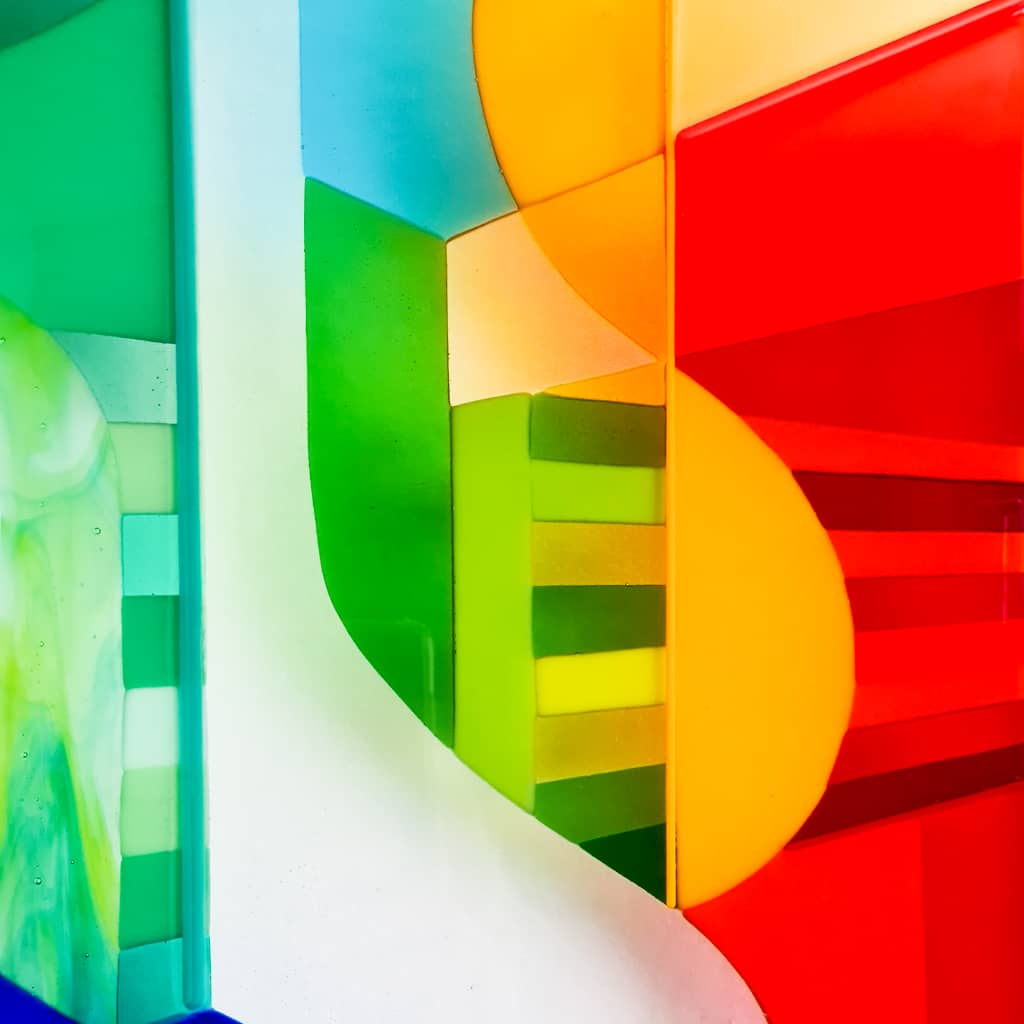


An interview with Linda Rossiter
How do you decide the colours once you have the initial black and white design?
I start at my computer, filling in the colours on screen.
The design is always black and white first, because I want to be sure of the structure before I think about colour. The design should always work without any colour.

Once the design is right, I'll begin broadly adding colour families - 'this area should be warm colours', 'this area will move from teal into blue'.
Some sections need stronger contrast against another - so I might introduce some black for example.
I fill in the different shapes with colour, creating a few versions of the design while I experiment. I'll probably produce several iterations before I’m satisfied that I’ve realised what I imagined.

Then I live with my chosen image for a while. I'll leave it on my screen and keep coming back to it, maybe changing a piece, changing it back until I’m settled, feeling right with the whole palette.
You have your own digital glass palettes. What are they?
Over the years I've built digital palettes that represent every glass colour I regularly use.
That's currently around ninety different colours of Oceanside art glass.
This means I can work with colours on screen that closely reflect the real glass I'll eventually use in the studio.
How can you tell when two or three colours work together?
For me it's more obvious when something is wrong. If a colour doesn't belong, I know immediately.
Then I’ll keep changing it until it’s right.
I look for contrast - that's how my Hard Edge style works best. That might be contrast in colour, transparency, opacity or brightness.
Instagram video showing my favourite glass colours
I only want to work with bold, vibrant colours - together with black and white.
I don't enjoy muted or unsaturated palettes. Perhaps that's why I never became a stained glass artist. I see a lot of brown and amber in traditional stained glass and it just doesn't excite me.
I'm not especially fond of purple or pink either - I like the basic rainbow palette of red orange, yellow, green & blue - but then of course every combination within this, whether Ruby red, Marigold, Lime green, Teal, Aquamarine or Caribbean blue (all such wonderful names, too!)

What creates the magic in your colour combinations?
Every piece has to earn its place. That's probably the simplest way I can describe it.
I spend a lot of time looking at one piece of glass and then the pieces around it. Each section has to contribute something to the whole.

The vibrant colours of 'Stairs' fused glass art roundel
I don't want uncertainty.
I don't want painterly, muddy areas.
I don't want colours that simply exist without purpose.
Every colour has to earn the right to be in the finished artwork.
How is the client involved?
Every commission is different.
Some collectors have strong colour ideas. They might say they want a cool palette, or colours that work with a particular room. Or they love the vibrant rainbow colours they see throughout my work and want me to explore those.
Some leave the entire colour palette to me.

So a large part of my job is listening carefully and understanding what they're hoping to feel when they see the finished piece.
How does the client approve the palette?
I’ll show the client one or two colour versions, well before any glass is cut.
We can discuss these in as much detail as needed - and I'll refine the colours until we're both happy.
Most changes that collectors make are relatively small.
They might ask for a particular area to be brighter, or perhaps they'd like a little less red in one section.
Occasionally larger palette changes happen too, and that's perfectly fine. The whole point of the design stage is to make sure I’m creating something they truly love.
Once the palette is broadly approved, what happens next?
That's when the real glass comes out.

I begin working with actual sheets of glass and refining every decision.
The colour is important, but so is opacity and transparency.
At this stage I'll lay everything out on the full size printed pattern and observe how the colours work together in the real world rather than on a screen.

Is raw glass colour different from the final fused colour?
Sometimes, yes.
Glass can change during firing.
Colours sometimes darken. The shades in a wispy piece of glass might merge. And some colours will react differently when placed next to others. Of course, light also affects how we see the finished piece.

So part of the challenge is understanding how the glass will behave after firing rather than simply how it looks as raw sheets.
What systems have you developed for checking colours?
Over the years I've built several systems that help me make decisions.
I lay out sheets of glass in their colour families.
I create glass pebbles in each colour.

I also use colour palette bars.
All of these give me ways to test and compare colours before committing them to a finished artwork.
What are colour bars?
A colour bar is a fused glass palette made from thin strips of the actual colours being used in a project.
Every colour bar is slightly different because every commission is different.
I can move them around the studio, hold them against the wall, or hold them up to the light.

They're a reality check.
A colour on a computer screen and a piece of glass are just not the same thing. So colour bars help me see how the glass will actually live in the real world.
They’re great for the client to see as well.
They also help me account for variations between different batches of glass, so I can confirm that everything will fuse as expected.
Do you ever change your mind later?
All the time. I'm always prepared to change an earlier decision if I think the artwork will be stronger for it.
Usually I'm looking for more contrast, more energy and flow or more clarity - making sure an element of the design stands out as I intend.
Sometimes it’s that one piece stands out too much. Or not enough - I'm looking for the right balance, but with something exciting too!
What happens if you change your mind after you've started cutting?
Then I cut it again. On one recent work, the centre section of Palm House was recut four different times using different colours and opacities before I was satisfied.
Video: recutting the central piece of Palm House
Sometimes that's what it takes.
Until it goes into the kiln, a piece can always be recut.
How is this different from traditional leaded or copper foil glass?
It's completely different. Traditional stained glass uses lead or black lines between pieces.
Those lines have a huge influence on how colours appear next to one another.

Stained glass jug panel - close-up section - by Linda Rossiter
My Hard Edge fused glass doesn't have those dividing lines.
The colours sit directly against each other, which means every colour decision becomes even more critical.

'Flamboyance' glass art by Glass Art by Linda
How did you learn colour theory?
My formal studies included graphic design, fine art and computer graphics, so I understand the theory.
I've also spent years working in art and design.
But to be honest, I think it was always there. It’s like having perfect pitch in music.
You can learn all the rules, but there's also an instinctive side to it.
For as long as I can remember, the right colours have simply made sense to me.

Leave a comment
Hard Edge glass art blog
View all


ABOUT THE AUTHOR
“Hi, I’m Kevin, Linda’s lifelong soulmate. I’m a professional scriptwriter by trade, for which I’ve won many awards.
My mission is to bring Linda’s genius for colour & form into plain words everybody understands and enjoys.”
