





Frequently asked questions
How much?
Every work is individual and completely unique.
Miniatures start from under £800 GBP
Larger works range £2,500 - £4,500 GBP or more, depending on size and complexity.
How long does it take to make a Hard Edge glass artwork?
As a guide, it takes at least 150 hours for me to make a large roundel.
It varies, depending on the size and complexity of the work.
This is usually spread out over the course of 3-5 months.
I don’t normally work on more than 4 projects at a time.
When is the next available start date?
Typically, I have a rolling 3 month wait before I can start your artwork.
Begin by completing the Commission Form.
This tells me you’d like to book the next available place in my schedule.
A ten percent deposit secures your place for you.
This is your guarantee you’ll own a Linda Hard Edge glass art original.
How did you become an artist?
I was never anything else. I just drew / coloured / painted / sewed / collaged / anything & everything, all the time, for as long as I can remember.
I got my first art award at 16, a 1st prize in The National Gallery competition “I See, I Paint”
I’ve been a professional artist all my working life.
I'm after something particular, can you help?
Absolutely! I’m very happy to discuss any project. If we both consider it practical and viable, then why not? Some of the most exciting artworks have come from original, fresh input from my clients.
What things do I need to consider before commissioning a Hard Edge glass artwork?
I’ve made a guide here that explains the steps in acquiring your commissioned glass artwork.
Hard edge fused glass art
What is Hard Edge Glass Art?
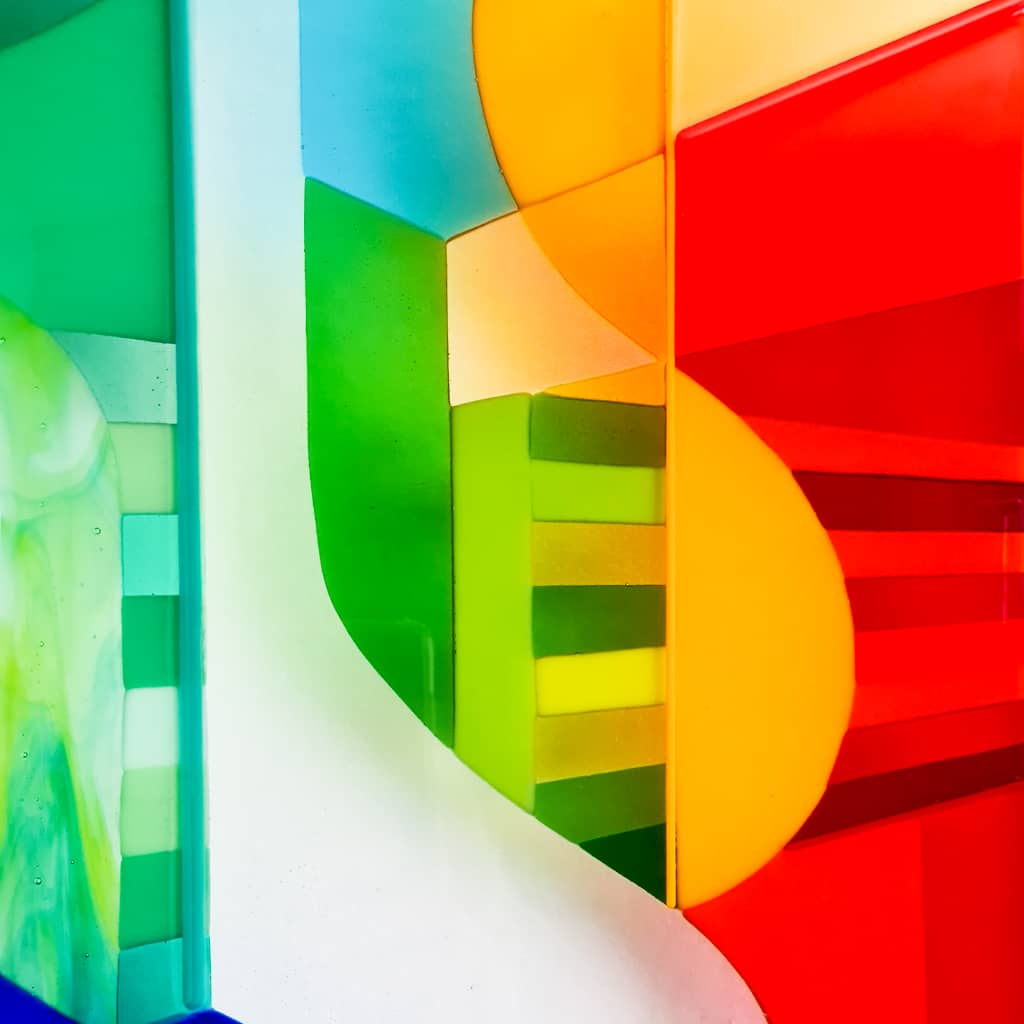
Hard Edge glass art has a distinct style, with hard edges. It relies on cutting lots of coloured glass pieces to an exact pattern, so they all fit exactly together to make the final image - like a jigsaw. There's an in-depth article here - The Hard Edge glass art style explained
Reimagining fused glass art
Will my reimagined work be an authentic original?
Yes. Artists throughout history have continuously developed their ideas and themes with the help of patrons. Picasso and Monet stand out as obvious examples.
Each reimagined work comes with a signed Certificate of Authenticity, plus a small discrete “Linda ‘26” signature etched on the back of the glass, so you can be sure your piece is an original.
How much does it cost to reimagine?
Typically a reimagined piece costs the same as the original, or perhaps a bit more if the redesign work is extensive.
Can I send you a photograph of what I like, and you tell me what it costs?
Yes. Once I can see an idea that you have, such as a photograph of a place, your rooms, or your beloved I can start to get ideas, and send you a range of sample costs.
I have an idea but am not sure if it’s feasible in glass art.
I love to hear ideas. I'm an artist!
Describe what you want as best you can, and I'll develop a possible solution for you which we can both then discuss until we get it perfect.
Email me at:
linda(at)glassartbylinda.com and tell me in your own words what you're thinking of.
Can I have my astrology sign embedded in the work?
Yes. My Gemini sun says this sort of redesign is great fun to do. You could have any symbol, name or sentimental motif you like. Can do!
I'm an artist. Can I have one of your originals with my colour ideas?
Yes. I love working with people with strong colour ideas. Send me a sample palette, and I'll revert with answers.
Delivery of your fused glass art
How much will shipping cost?
Please contact me for a quote for secure, tracked delivery of the artwork you have in mind.
Please also be aware that outside the UK, the customer may be responsible for any additional customs/taxes that may be charged in their country.
Can you deliver to my country?
Yes, I can arrange for delivery to almost every country in the world. Please contact me and I will find a solution.
Care and display of your fused glass art
How do I care for my fused glass?
Fused glass items can be hand-washed in warm water with a mild detergent. Do not put them in the dishwasher, or the microwave.
How do I display Hard Edge glass art?
There are a wide range of ways to display glass, so I've created a separate page to go into the details. Please take a look here: How to display Hard Edge glass art in your home
Production of fused glass art
Do you use a laser or waser to cut your glass?
No.
Lasers are used primarily for replicating patterns which is of no use to me as everything I do is a one-off.
I very much enjoy cutting glass by hand. I don't mind how difficult the cut is, I always want to try, and usually get it right :)
Additionally, cutting by hand gives me flexibility to adjust shapes and sizes as inspiration strikes during the project.
This is something a laser cannot do without a load of faff.
As I say, lasers are best used for the bulk reproduction of patterns.
Do you sell your stained glass patterns?
I don't sell my stained glass designs, no. I put many hours into my designs - they're very much part of what I do, and my style - and so they're only ever for my own use.
Do you teach fused glass in person, or offer online courses?
I don't teach glass art, or offer any online classes or tutorials. I have far too many ideas of my own to get through yet :)
I'd recommend finding a local one day course to learn the basics of cutting and handling glass. This is what I did ... I learned to cut, to work safely, and what tools I actually needed to buy.
Also, if you're on Facebook I recommend joining these two groups:
FusedGlassHOW?
and
Fused glass Enthusiasts UK
The first one particularly is very good for new fusers - no one will mind beginner questions!
There's one key rule in fusing ... you must fuse the same glass together ... so, only Bullseye glass, or only Oceanside glass.
Many people just paint on glass, so this can be horticultural glass. All this is the kind of learning you'd cover in a short course to get you going in the right direction!
What glass do you use?
I use Oceanside 96 glass, purchased in the UK from Creative Glass Guild and Pearsons Glass
What kiln do you use?
I have a Pro-Fuser kiln from Kilncare
What software do you use when designing stained glass patterns?
I redraw my pencil sketches in Affinity Designer so they're scalable vector files.
Once this black & white version is perfect, I'll colour it in Adobe Photoshop.
And when I've finished everything, I use Adobe Lightroom to fix my photos.
How do you cut your templates?
I use a Cricut machine for cutting out the pattern pieces. The model I have is an Explore Air 2.
What material do you use for your templates?
I use sticky-back vinyl ... I found that the cheapest roll of permanent vinyl stays on long enough to cut and grind the glass, and still peels off easily when I'm ready.
Currently I'm using Cricut permanent vinyl
What's the tool you're using to break the glass?
I'm using Silberschnitt running pliers. They're fairly expensive but I think they're really worth it. The head swivels, and it's important to keep it at right angles to your cut line. They don't need much pressure ... hold the very end, press gently until you hear a "click" then move along the cut and do the same again.
How do you cut glass so well?
That's a big question 😁
There's plenty of basic cutting rules you'll find in any number of YouTube videos.
Beyond that, I practice a lot - I've already cut almost 200 pieces this week. I think about what I learn - why the glass broke in a certain direction, which glass is easier to cut, which always breaks in the wrong way (ruby red 😁).
So I know which glass to cut exactly on the line, and which to cut a little wider, and grind afterwards.
I keep the glass warm and clean.
I use good tools - a Toyo Super Glass Cutter and Silberschnitt Cut Running Pliers. I keep them clean and oiled.
And each day I try to improve ...
Do you use a glass saw?
Mainly I score by hand with a Toyo pencil grip cutter, and break with Silberschnitt running pliers. I challenge myself to be as accurate as possible - but I do use a grinder to neaten the edges afterwards.
There are also a few pieces I design specifically to be cut with a Taurus 3 ring saw.
I don't use it much (it's slow, wet and noisy) and it certainly doesn't replace cutting by hand, but what it does, it does very well!!
I use the standard blade that was supplied with the glass saw.
Tell me about your Ultrasonic Cleaner
It's a 30ltr ultrasonic cleaner from Amazon.
It's got plain tap water in, plus isopropyl alcohol if I'm cleaning pieces BEFORE they go into the kiln, and vinegar if I'm cleaning finished fused work.
It's great for me, as I work with hundreds of small pieces. I used to scrub each one with a toothbrush.
The cleaning cycle lasts 15 mins, during which time I can be doing something else.
The cleaner removes the grinding dust, grease and any other marks that might otherwise cause a defect during fusing.
I then rinse and dry the pieces by hand.
It takes a few mins to set up, so it wouldn't suit someone who works with larger pieces of glass, as they mustn't touch in the cleaner.
Do you dam the glass in the kiln ready for firing?
No. Glass naturally wants to get to a 6mm thickness when it's in the kiln on a full fuse programme.
I'm fusing 2 layers of 3mm glass. So what's going in is a total of 6mm thick, and so it'll keep it's shape without requiring any dams.
If I put in a single layer of 3mm glass, it would "pull in" to get to 6mm.
Conversely if I put in three layers of 3mm glass, it'd spread out to get to 6mm, and would need damming to keep its shape.
Why do you put clear glass on top?
Fully fused glass naturally wants to be 6mm thick, so a single 3mm coloured layer would "draw in" and change shape. So in order to make sure my straight lines stay straight, it needs a layer either on top or underneath.
I always put the clear on the top. While it takes a lot longer, it has the benefits of
- adding depth to the piece
- keeping my hard edges straight
- helping reduce the appearance of devitrification, where the surface of the glass can turn cloudy
How do you control unwanted bubbles in your glass work?
I do a few things that help reduce the risk of bubbles ... First, I make sure the glass is very clean.
Then I sprinkle glass powder between the layers (the finest grade of frit)
Finally I have a good bubble squeeze schedule.
You'll always get tiny champagne bubbles, but big deforming bubbles can be avoided with the above.
Do you have a question about Hard Edge Glass Art?
Please write to me, Linda Rossiter - I'll do my best to give you a prompt and useful reply.
