





Facts, data, passions:
The Linda Interview
Updated August 2026
A great deal has changed since we first interviewed Linda for this page. Her artworks have become more complex, new commissions have taken her in unexpected directions, and thousands more people have followed the work as it develops in her studio.
So we sat down with Linda again to talk about the facts, ideas and passions behind her work today.
How many original commissions have you now created, and where in the world have they gone?
I’ve created more than 75 commissions.
Quite a few private ones this year also.
They’ve gone to the USA, Canada, Europe, the UK, South Africa and Australia - I think that’s everywhere.


How complicated can one of your larger artworks become?
The complication is in both the number of pieces and the design.
Increasingly there are more pieces in my work, as I develop sections that need that complexity to get the exact effect I want.
Previously, I might not have had the courage - or the skill - to cut so many tiny pieces.
But it’s very rewarding when it works. A single large work can have up to more than 300 pieces.
Alternatively, a work might have a lot fewer pieces, but the shapes themselves are far more complex.

People sometimes assume the detail is painted onto the glass. How is it actually done?
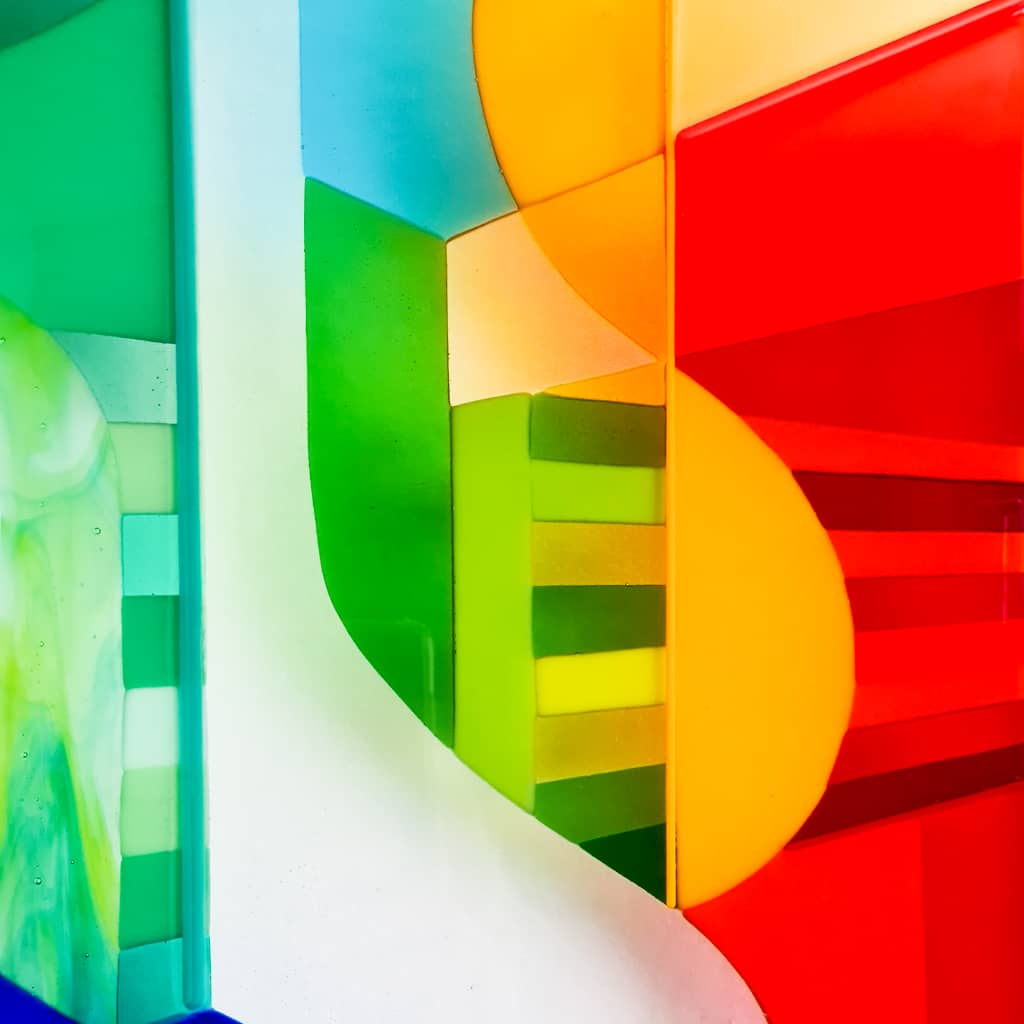
The colour is in the sheets of glass themselves.
I start with raw glass of each colour.
I have around 90, maybe even 100 colours now.
I select exactly the colours that I want and cut each piece to fit together.
There’s no painting.
There’s no additional colour. I’m using the actual colours of the glass.

How do you choose your colours?
Intuitively.
I know broadly what areas of colour I want. Then I look at the colours together and know when they’re right.
It's a huge part of what I do - there's a separate article on How I decide my art palette if you're interested to learn more.

Which recent artwork stretched you the most?
'Orchid Bloom' stretched me because it was based on a painting by another artist, Matthew Green.
You can see that the painting itself was full of interlocking organic pieces.
There was nothing straight. It was as if someone had dropped watercolour paint onto a piece of paper!
Every one of the curved pieces had to fit very tightly together.
If one of the pieces didn’t fit, it would have spoiled the overall flow of the work.
And as it wasn’t my work to start with, there was greater pressure to make it look perfect - make it look like what Matthew had intended in the first place.
What is it about glass that painting or sculpture can’t give you?
Glass gives you light.
You move it. You hold it up to the light. Holding a work near a window is so different to putting it on a wall in a dark room, or seeing it in a church.
Sometimes you see stained glass in a church and actually it looks nothing because there’s no light behind it. Then you light it properly and it’s the most glorious thing.
I think the intensity of the colour and the light are so different to a painting.
After all these years, can glass still surprise you?
I don’t think surprise is the word.
I know very much what I want to get out of the glass, so I’m not looking for a surprise really. That wouldn’t be my goal.
I think delight.
It still continues to delight me every time.


What’s the first thing you look for when you open the kiln?
When I open the kiln, I’m looking to see the image that I’ve had in my head for weeks up until that moment.
Obviously, I’m looking to see that it’s perfect, but I wouldn’t expect a problem.
I know it’s great fun and a great social media thing to show disasters - but I wouldn’t work in a way that created a disaster from a large piece of work.
That wouldn’t be sensible. It wouldn’t be businesslike to work for three months on something and open the kiln to see it broken.
So I test all the way through. I know what it is I expect.
When I open the kiln, I’m looking for something wonderful.
Opening the kiln

What happens when one piece of glass fits almost perfectly, but not quite?
If I fused together two pieces of glass that didn’t quite fit, the glass would move in the kiln.
Glass wants to be six millimetres thick when it’s fully fused. If there’s a gap between two pieces, science just says it will move.
Then my hard edges will no longer be hard edges.
However, I wouldn’t put two pieces that didn’t fit into the kiln. I spend a lot of time making sure the pieces do fit before they go in.
A lot of people see that precision and accuracy and don’t understand how it can be done, or think it’s over the top. But it completely gives the effect that I’m after.
Some people ask what tolerance I allow between pieces.
There’s no tolerance at all :)
How do you know when an artwork is finished?
It’s obvious to me when it’s finished.
I’ve designed it at the start of the projecty, so I know how it’s supposed to look. I put a lot of time and effort into those designs.
I don’t start cutting glass with a draft, or half an idea.
I only start cutting glass once I have a very clear design and I know what I’m doing.
I’ll have it up on my computer monitor. I’ll walk past it for a few days. I’ll print it out full size and look at it.
I’ll see it in black and white, and also in colour.
After more adjustment, I'll know when the balance is right.
The actual glass artwork is 'finished' when it matches the design that I’ve been imagining all that time.


What do you want somebody to feel when they first see your work?
I want them to love it.
I want them to absolutely just think, what great joy.
That’s it. That’s how I feel.
I want people to look at it and go, “Oh, that’s wonderful!”
Why is joy so important in your art?
I don’t like miserable art. I don’t see the point in it.
I’m creating people’s memories, the things they love. The work should bring them joy.
What’s the point in a piece of artwork that brings you down? I wouldn’t have that.
Sometimes you go into galleries and see these morbid pieces, or such angst in a painting.
I’m not a person who could live with that, for sure.
You’ve said you don’t understand why so much art is beige.
What do you mean?
I see people buying art because it matches their sofa, their rug or their curtains, and it’s terribly safe.
It looks nothing. It has no impact at all.
The easiest route is often to choose something that’s the same colour as everything else in your room.
I’d like people to choose the opposite. Even if you just learn the very basics of colour theory, pick opposite colours or pick three colours.

What do collectors bring out of you that you might not discover by making art entirely for yourself?
They bring out new topics.
People come along wanting subjects that I’d never think of. This year for example I’ve already done an Italian coastline, a dog, a wedding bouquet and a black and white face.
They’re not what I’d have in my mind to start with.
Sometimes it’s a topic that’s more normal, like botanicals, but done in extraordinary colours because that’s what the collector wants.
Collectors also bring out different shapes.
Sometimes they want the shape of the artwork to fit into a certain space, in a window or between two other artworks.
I can be very flexible. I’m not just churning out a square artwork every time.
I’ve made a floral arrangement where the edges of the glass follow the edges of the flowers. It isn’t just a round piece.
I’ve started making more irregular shapes because I can. Then I can work with my blacksmith and make a stand absolutely custom to it.
That’s much more interesting.
When a collector arrives with a memory, a feeling or a loose idea, what are you listening for?
I’m looking for what really excites them in what they’re saying.
Some people come with a lot of ideas. They’ll give me all these ideas and then say, “I’m sorry, this is too vague” or “This is too long.”
But the more you look at those ideas, you start to see what’s most important to them.
I think of visual imagery for each thing the client has suggested. Then I start thinking about which sets of imagery go together.
It’s always going back to what they came and asked for in the first place.
Often, the very first thing they said when they filled out the contact form is the true one.
For everything else they say later on, sometimes that very first sentence was the true one.

Has a collector ever suggested something that took your work somewhere you weren’t expecting?
Oh yes, often.
A recent one was working in black and white on Mono Lisa.
Lisa said she’d been prepared to buy a coloured piece from me if I wasn’t able to work in black and white.
But she showed me photographs of her house and it was completely black and white.

It wouldn’t have been right to create a coloured artwork.
So I worked with her and developed a monochrome palette that worked perfectly with her home.

I don’t particularly like the word challenge. I think it’s overused. Everything becomes a challenge.
It has negative overtones, as if to say, “This is challenging. I don’t think I can do it.”
So challenge isn’t the right word. But I do like to be stretched by people’s ideas.
What’s it like sending away an artwork you’ve lived with for several months?
I really like living with art that I create, at least for a week or two before I send it away.
I want to see it in all different lights. I want to see how it sits on the stand. I want to come into the studio in the morning, open the blind and see how the sun hits it.
I want to know what that person’s going to experience, so I very much like living with the pieces for a little while.
But then it’s time for them to own it, and it’s time for me to do something else.
When I’m focusing on a piece, it’s probably all I’m focusing on. It takes up a lot of my energy.
It’s actually quite good then to let it go and say, “That piece is gone. I’ve seen it off going in the UPS van.”
It’s time to clear my head and start again.

I did have one piece recently, Vernazza, that I lived with for more than six months because the client was moving house and asked me to hold onto it.
I did grow very fond of that one.
Although it showed the Italian coast, it was very representative of many Mediterranean coastlines and places I’d visited. It brought out the sunshine, the heat and the light in those places.
Every time I saw it, I thought, “Oh, I want to go there.”
I loved looking after the piece, but I was also excited for her to receive it because I think it will bring out that memory in her.

You’ve shared thousands of studio posts with a large international audience.
What have art lovers taught you about your own work?
I think I’m very lucky because I don’t receive negativity through social media, or very rarely.
I often see people being criticised, which I’d really back away from.
The comments I get are really encouraging and really supportive. People are fascinated. They like to watch the process and not just see the end result.
People come back time after time. They say, “I watch your work every morning with my coffee because it gives me that inspiration for what I’m doing today.”
People like watching it.
But at the same time, I’m not influenced by what other people say about my work.
My influence is me. It’s all the things I’ve taken on board and the things that I see.
I Make and Share, but I’m not sharing because I’m indecisive.
I’m sharing because I think it’s lovely and people will enjoy it.
Why do you prefer marketing online to pursuing galleries, exhibitions or more awards?
I’m a private person.
I’ve never been a great one for visiting galleries, joining in art groups, going to exhibitions or doing those things.
Throughout my work and throughout my life, I’ve tended to work alone with my own ideas and my own thoughts.
To then take a piece of work and put it into somebody else’s hands to market and talk about, and have cheese and wine evenings and all the rest of it, seems very false to me.
I wouldn’t be comfortable doing it.
I’m much more comfortable marketing myself online in a modern way that I also understand, because it’s part of my background in marketing.
What haven’t you made yet?
The truth is, I don’t know what I haven’t made yet.
It’s whatever the next commission is.
The next commission will be something different that makes me go
“Oh, that’s interesting. I’ve not thought of that.”
That’s what the next piece will be.
