



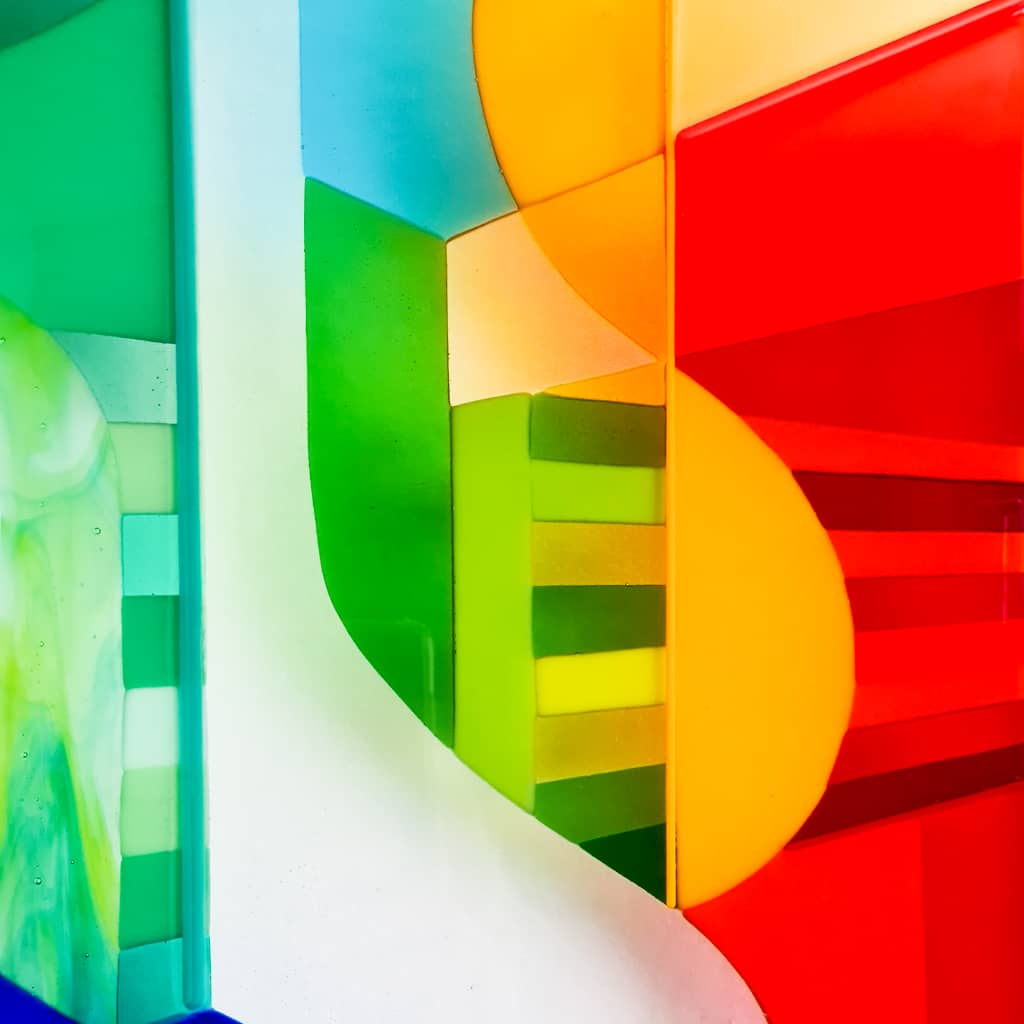


"I'm very curious to see if any of my paintings could translate into your medium."
That was the email that arrived from Miami.
It came from Matthew Green, recently retired after a career spanning almost thirty years as a meteorologist working in emergency management. Today he's an artist, creating intricate paintings with coloured inks.
His question wasn't about buying a piece of glass art.
It was about curiosity.
Could one artistic language become another?

At first, Matthew imagined one of his paintings being recreated in glass. But almost immediately he changed his mind.
"I was thinking about it more as I slept and really what I'm looking to do is unfair for you. I really just wanted to see one of my paintings in glass. I won't ask you to be constrained by another artist's design."
So rather than asking Linda to copy his work, he invited her to respond to it.
Neither artist knew quite where that would lead.
An artist... twice
Matthew's artistic life began long before Miami.
"We were required to take an art class for graduation… any art. I chose painting. The first assignment was to do a hard edge painting. I started the painting in class and took it home over the weekend to continue … when Mrs Mullen saw it she was astounded/shocked/impressed and told me to do whatever I wanted in the class.”
“That was my one and only art class in high school but I continued to paint with a passion and ended up receiving the art award at high school graduation.”

Then life took a very different direction.
“Sadly McGill offered no fine art classes. None. I tried. But my art and my future as an artist dried up over the course of the next few years. At most I painted one new piece every few years.“
Instead of art school, he studied meteorology and spent the next three decades helping emergency managers prepare for hurricanes and other severe weather events across the United States.
"My job was basically to be the liaison between the people who made the forecast and the people who used it."
His work demanded precision, communication and calm under pressure.
“With Covid and the lockdowns. I stumbled upon painting with ink as a coping mechanism for the isolation of quarantine. Due to my job at the hurricane center I had to be extremely careful that first year limiting my exposure to others. My art was rekindled by that opportunity and I haven’t stopped since.”
"I ordered a bunch of art supplies on Amazon and just stumbled into it."
That simple purchase led him to discover coloured inks, a medium that immediately fascinated him.

"When you mixed it with water, it had the feel of watercolour. But once dry, it became waterproof and lightfast, so you could layer the colours."
He found himself exploring techniques he hadn't seen elsewhere.
Even more importantly, ink taught him something about himself.
"It's forced me to learn to be very patient."
Each layer needed hours to dry.
The ink flowed according to gravity and surface tension rather than complete control.
"You can sort of guide it, but you can't really control it."
It was an idea that would echo through the commission itself.
Living with art
Matthew doesn't simply create art.
He surrounds himself with it. He’s a collector too.
He's been collecting since high school and estimates there are now well over a hundred pieces in his home, ranging from paintings and sculpture to animation cels, even glass.

What struck me wasn't the size of the collection, but something else:
"I can tell you the story behind everything. Everything has a story about how I came to have it."
Later he laughed as he described his apartment.
"Some people paint their walls. I put art everywhere."
That love of original art has also led him to commission artists several times over the years. One commission celebrates the streets where he grew up in New Orleans. Another captures the memory of his much loved cat.

So when Matthew approached Linda, he wasn't discovering the idea of commissioning.
He already understood the relationship between collector and artist.
"You have to accept that it's the artist's vision and their work. You're not the artist who's producing it. You have to be willing to give up control."
That philosophy shaped everything that followed.

The orchid
Matthew originally suggested several possible paintings.
One eventually stood out. An orchid.
Its flowing forms and luminous colours seemed perfectly suited to glass.
Linda saw the same potential:
"Matthew's original design really appealed. It was a challenge to see how to turn an ink artwork into glass. It was full of strong colours and contrasts. I knew it'd look good in glass."
But there was another challenge.
Matthew imagined displaying the finished artwork in front of a window in his Miami apartment, allowing sunlight to shine through it.
That meant every colour needed to remain transparent. No opaque glass could be used.
The piece would live with light.

Letting another artist in
Many artists protect their work.
Matthew did the opposite. He embraced collaboration.
Looking back, one of the most striking aspects of his interview is how naturally he talks about trusting another creative mind.
The project was never about reproduction.
It was about interpretation.

Throughout the design process he watched sketches develop, discussed colours, explored different sizes and considered display options.
Rather than handing over an order, he became part of an ongoing conversation.
In fact, he consciously stopped himself becoming too involved.
"I actually had to stop myself. I didn't want to micromanage the process. I wanted you to use your skill and experience."
He also understood that the outcome shouldn't be an exact copy.
"It doesn't have to be a one for one reinterpretation. That's part of the artistic process. You're actually making something."
Later he reflected on what surprised him most.
"The collaboration process was amazing."
And after experiencing it for himself, that enthusiasm only grew.

Two different ways of making art
Listening to Matthew describe ink, and watching Linda create Orchid Bloom from more than a hundred individually cut pieces of glass, it's difficult to imagine two more different processes.
Matthew works with movement.
Linda works with precision.
Matthew allows colours to flow.
Linda builds them piece by piece.
Matthew accepts the unexpected.
Linda carefully engineers every line.
Yet both artists are chasing exactly the same thing.
Light.
Perhaps that's why the commission worked so naturally.
Each recognised something familiar in the other's medium.
Seeing your own work differently
Every artist knows their own work intimately.
Or thinks they do.
Seeing it interpreted by someone else changes that relationship.

When Orchid Bloom arrived in Miami, Matthew wasn't simply looking at his painting.
He was looking at something new.
"It's gorgeous."
"As the sun shifts during the day, I love the way the light changes what your eye focuses on in the piece."

That isn't something ink can do.
The artwork changes as daylight moves across it.
Morning is different from afternoon. Cloud is different from sunshine.
The piece never quite stands still.
Matthew had hoped his painting might work in glass.
Instead, glass revealed possibilities that hadn't existed before.
"I knew that my painting would work well in this medium and now I'm inspired to push this further and see where it can go."
For one artist to say that about another artist's interpretation is perhaps the highest compliment possible.
Living with Orchid Bloom
Today Orchid Bloom occupies a prominent place in Matthew's home, which was something he’d imagined from the beginning.

Each day offers a slightly different conversation between colour, transparency and sunlight.
"Everyone thinks it's amazing."
Several friends even assumed Matthew had produced it himself and wanted to buy one.
Others simply admired how naturally it had become part of his collection.
More than a finished artwork
When I asked Matthew what had made the whole experience memorable, his answer wasn't about the final piece alone. It was about the journey.
"I felt like I was part of the process at each step."
He particularly appreciated how informed he felt throughout.
"You're very communicative. You anticipate the things that will come up and the kinds of questions someone might have. It just made everything incredibly easy."
In the end, his conclusion was wonderfully simple.
"The entire process was really wonderful. Thank you."
Then, with a laugh, he added something neither he nor Linda could have predicted when that first email arrived from Miami.
"I've made fabrics with my paintings and had them embroidered onto pillows. I really knew that transitioning to glass would work.
Now I have tons of people who want one in glass. Hahaha."

A shared act of creativity
It's tempting to describe Orchid Bloom as a commission.
It certainly is.
But that word doesn't quite capture what happened here.
This wasn't one artist copying another.
It was one artist trusting another enough to reinterpret an idea in a completely different language.
Matthew's original painting still exists.
So does Orchid Bloom.
Neither replaces the other.
Instead, each helps us see the other differently.
Perhaps that's what the best artistic collaborations achieve.
They don't preserve an idea.
They allow it to become something that neither person could have created alone.
Leave a comment
Hard Edge glass art blog
View all


ABOUT THE AUTHOR
“Hi, I’m Kevin, Linda’s lifelong soulmate. I’m a professional scriptwriter by trade, for which I’ve won many awards.
My mission is to bring Linda’s genius for colour & form into plain words everybody understands and enjoys.”
