





Introduction
“It feels simple at first, yet if you look really hard you'll see there's a small room with a table hidden inside this jungle that is Toucans”.
It’s got a bold subject. Yes. Strong colour. Instantly recognisable.
But the longer you spend with it, the more it opens out.
VIDEO: The backstory of Toucans Hard Edge fused glass artwork
My Impressions
“I liked Toucans straight away.
There’s something about the expression of the bird. Bright, slightly mischievous, and oddly optimistic. It pulled my eye in almost automatically.
That’s what initially drew me.
I look because of that cheerfulness.
Then I stay because there’s more going on, almost in the way Franz Hals’ Laughing Cavalier works for me.
I found myself looking past the bird into the structure around it. The depth of it. The sense of a dense, layered forest rather than a flat image.
And then something else appeared.
A kind of inner space. A room hidden within the foliage. Once you see it, you can’t quite unsee it.


The same with the vases. Not obvious at first, but vases are there, part of Linda’s underlying visual language.
That’s what keeps it interesting.
It starts with a simple hit of colour and character, then gives you somewhere to go.”

Not Commissioned. Created Freely
This piece wasn’t made for a client.
Linda created it for herself, without a brief or constraints.
That changes the outcome - the difference between just solving a problem - and following a compelling idea to see where it leads.
You can feel that freedom in the way the composition develops. It’s not trying to meet a requirement.
It’s building something on its own terms.

What You Actually See
At a glance, it’s representational.
Look again and it develops further in unexpected ways.
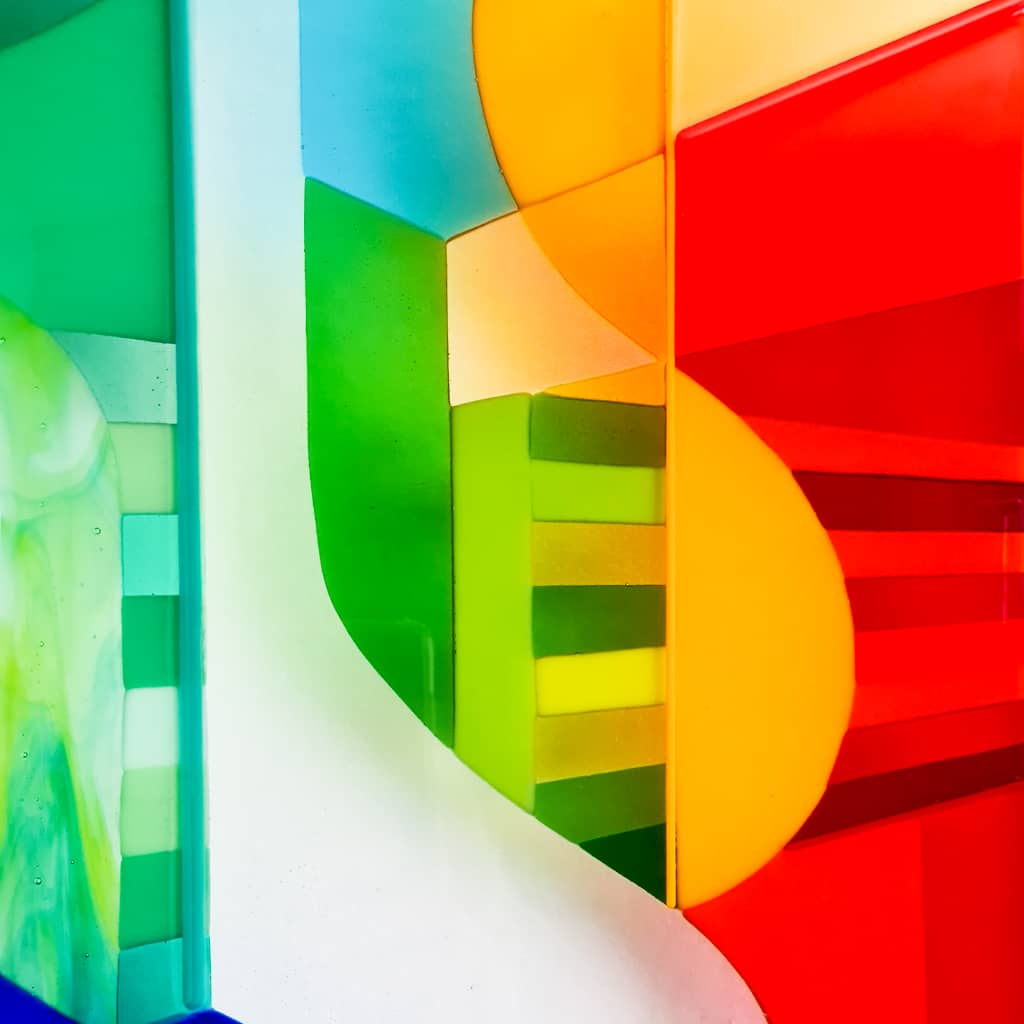
What holds the piece together isn’t the subject, it’s the almost abstract structure. Shapes meeting cleanly. Colour held in place without blending, softening or fuzzing.
This is exemplary Hard Edge glass in practice. Not as a label, just as a way of constructing an image.
Every line has to be clear and defined. If it isn’t, the process will unravel. It comes down to precision.
That’s why the clarity feels so deliberate. Not a “slip of the brush” but a firmly held personal intention.

A Forest, Not a Picture
The more time you spend with it, the less it behaves like an image at all.
It reads better as a space.
Not through classical perspective, which is certainly there, but through layering.
Shapes sitting behind and alongside each other, creating depth - even a room, a table and a chequered floor if you look closely.
There’s no fixed route through it. You’ll find your eye moves freely through, picking out fragments, patterns, elements, suggestions of form.
Some resolve. Some don’t.
That ambiguity is part of what gives it life, a common feature of Linda’s work.

The Miniatures
The large roundel already carries the idea.
The miniatures don’t bring it to life, they extend it.
Now there’s a small group an ornithologist would call a Durante of Toucans.
Placed together, they deepen the sense of environment. It’s less a single artwork, more a loose arrangement that can be adjusted depending on the space.
VIDEO: Toucans Miniatures
The Eye
You can’t talk about Toucans without mentioning the Eye.
It’s the first thing most people respond to.
That small detail does a lot of work for the viewer.
It’s what draws you in initially, and it holds up over time. It doesn’t fade or become background. It keeps doing its job. It doesn’t blend. It keeps pulling you back.
Technically, it’s built in the same way as everything else. Small pieces of glass, often cut from recycled offcuts, and placed with precision, a signifier of contemporary Hard Edge art glass.
Everything is used where it fits best.
At this scale, there’s no room for approximation. It either works or it doesn’t.
Here, it works.
VIDEO: How did I make the Toucan's eye?
How It’s Made
What isn’t obvious from the finished piece is how much adjustment sits behind it.
Selecting colours. Rejecting them. Swapping them out. Trimming edges to remove the smallest gaps.
These refinements are what make it hold together, successfully translating it from a starter graphic design to a large and impressive piece of glass artwork.

Remember: Hard Edge glass is unforgiving. If two pieces don’t meet properly, the heat will close the space and the line disappears into “fluff”.
So the process is slow at the start. Careful. Repetitive.
For Linda, that isn’t a chore. When she’s engaged with a piece, that level of fine detail is part of the fascination.
It’s where the work happens for her.
Yet in her process videos, she makes it all look normal and straightforward. And not just this piece. Any Linda piece.

Where It Came From
There’s a personal starting point for this work.
Linda grew up around toucan imagery through Guinness memorabilia. The image stuck.

Rather than copy from a single source, she built her own reference.
Studying birds in an aviary. Looking at patterns and repetition in plant structures. Observing how colour behaves in natural settings.


All of that feeds into the final piece.
Not directly, but as a set of influences that get reworked into something new.
Living With It
Toucans sits easily in a room.
It works with a spotlight, but also further back in softer light.

I’ve tried it in different positions and it holds up.
It’s particularly good near plants. Real foliage seems to reflect and echo what’s happening in the glass.
VIDEO: How to display Toucans glass art
Closing
Toucans starts with something immediate.
Colour. Character. Presence. Optimism.
It doesn’t stop there.
The longer you spend with it, the more it reveals.
That’s why it stays.
See the complete glass artwork here: Toucans: Large glass art roundel & Miniatures
Leave a comment
Hard Edge glass art blog
View all


ABOUT THE AUTHOR
“Hi, I’m Kevin, Linda’s lifelong soulmate. I’m a professional scriptwriter by trade, for which I’ve won many awards.
My mission is to bring Linda’s genius for colour & form into plain words everybody understands and enjoys.”
