



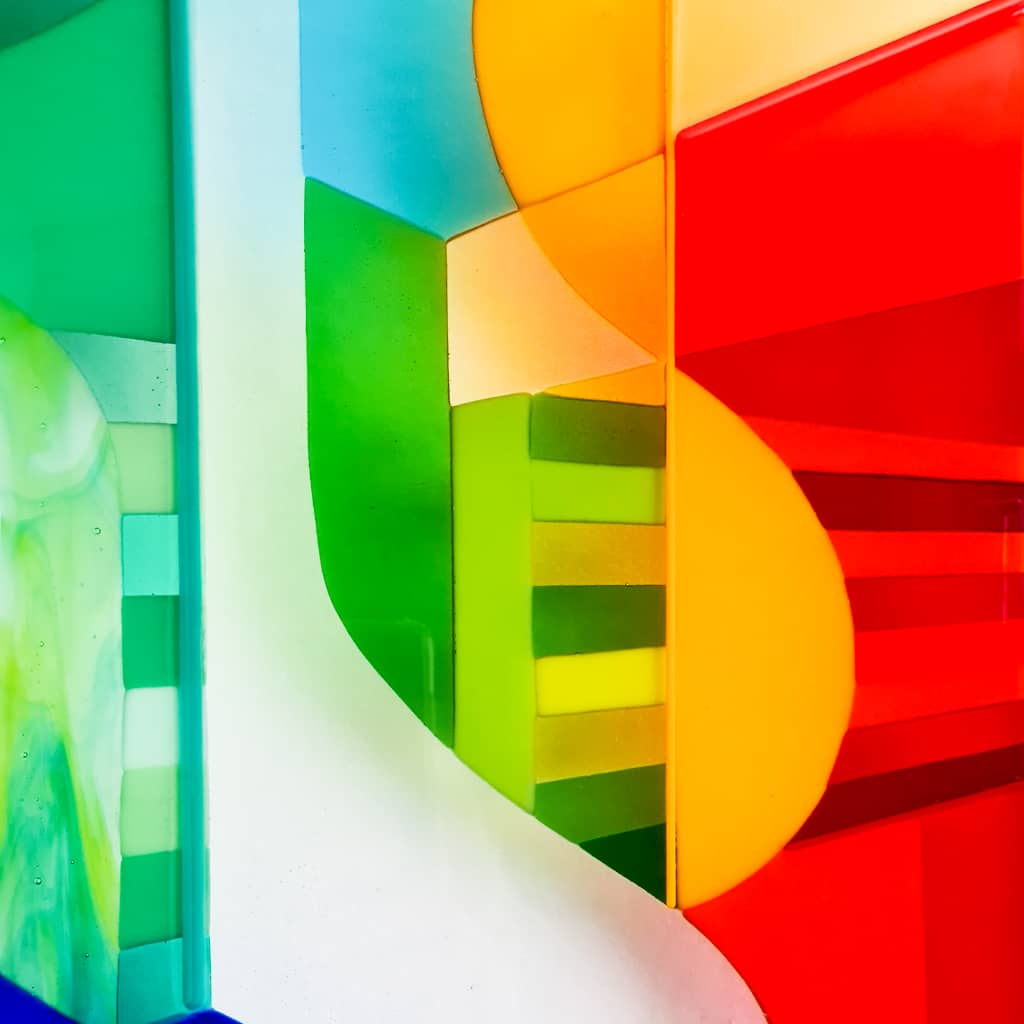


Aleta Doran has spent much of her life studying, making and collecting glass, so finding something she hadn’t seen before wasn’t easy.
She found it in Linda’s Hard Edge work.
But behind her two commissions was something more personal.
She wanted to remember two lives through colour, happiness and everyday presence rather than loss.
Most memorials live outside the home
A headstone.
A church plaque.
A name carved into stone.
They mark a life, but they rarely feel like the life itself.
For Aleta Doran, that never felt enough.
You see, Aleta isn’t a casual collector.
She’s a mosaic artist, a stained glass researcher at the University of Chester
- and recently the Artist in Residence at Chester Cathedral, where her work around stained glass artist Trena Cox led to the major exhibition Trena Cox: Reflections 100.

As a member of the British Society of Master Glass Painters, she spends her life looking closely at glass. How it is made. How it survives. Why it matters.
So when Aleta talks about craftsmanship, collectors are happy to sit down and listen.
And when she chose Linda’s work for her own home, it came from decades of living with glass in every form.
In the aftermath of family bereavement, she found herself asking a harder question.
How do you remember someone properly?
Not formally.
Not dutifully.
But truthfully.
Her answer was glass.
Glass was always there
Aleta’s relationship with glass didn’t begin with collecting. It started in childhood.
Her mother collected glass objects. Not grand museum pieces, but unusual vases, bowls, and handcrafted pieces chosen for colour, texture, and presence.
“My mum liked colour, she liked surfaces, and she was interested in choosing things for the house that were unusual.”
Glass became part of the atmosphere of home.
“It was always around me, and I was really fascinated by it. Glass is quite mesmerising, isn’t it? Its different qualities, its colour … there’s nothing quite like it.”
That early fascination never left.
Although trained as an Illustrator, Aleta became a mosaic artist where she found herself drawn to only one material.

“The only thing I wanted to use was glass. I wasn’t interested in ceramic tile or stone. It had to be glass.”
Why?
Because paint could not do what glass could do.
Because coloured pencil could not do what glass could do.
Because light changes everything.
“You couldn’t communicate that quality of when light hits or travels through glass. The only way, then, is to work with glass.”
Aleta still keeps pieces that connect directly to that story.
A blue etched vase bought as a student from a London craft gallery for her mother still sits in her lounge. Two Venetian ampulla-shaped vessels came later, collected over several visits to Venice, a city that holds a special place in her life.
They are not just objects.
They are markers of time.

A collector’s eye
Collectors with experience stop buying more of the same.
They start looking for difference.
For contrast.
For something they haven’t seen before.
Aleta’s collection reflects that.
A stained glass piece by Tamsin Abbott, created for Aleta’s Trena Cox: Reflections 100 exhibition at Chester Cathedral, was a part of the exhibition, a work that Aleta had to buy for herself after the show had ended:
“It looked so beautiful in the cathedral that I couldn’t bear to part with it.”

Stained glass artwork by Tamsin Abbott. Photograph © Aleta Doran
She also lives with her own mosaic work, including an angel mosaic built with white gold smalti and iridescent glass to create a sense of ethereality.
Another project, Constellations, which Aleta curated for Chester Cathedral, brought together contemporary women mosaicists and a suspended installation of tiny star-like mosaics, creating a floating night sky inside the cathedral.

This isn’t decorative collecting.
It’s a life built around looking closely.
What separates good from exceptional
Ask Aleta what makes glass art exceptional, and the answer comes instantly.
“Craftsmanship.”
Not fashion.
Not trend.
Not reputation.
Skill.
“Whenever I look at a piece of art or craft, I’m looking for skill. I want to look at something and think, wow, how did they do that?”
For artists and serious collectors, that recognition happens quickly.
You see the years inside the work.
The experimentation.
The failed attempts.
The mastery of difficult materials.
And too often, she says, people miss that.
“There is often now a lack of appreciation for skill. For the time and experience it takes to create something.”
Anyone who has ever priced original art knows the conversation.
Sometimes politely.
Sometimes bluntly.
People imply they could make it themselves.
“And you think, well, you couldn’t, could you?”
Because real work is never just the finished object.
It’s years.
Years of testing.
Years of mistakes.
Years of learning what the material will and will not allow.
That is what serious collectors recognise.
Why Linda’s work stood apart
This is where Linda entered the story.
Aleta had already lived with stained glass, collected glass objects, researched church windows, curated exhibitions, and surrounded herself with work she loved.
She was not looking for more glass.
She was looking for something original.
Something she had not seen before.
“I have a piece of stained glass on a lightbox in my house, and your work was still something I could display in the same way, but it was completely different in its appearance.”
Rather than collecting similar work, she wanted contrast.
“I would look for something that’s eye-catching because it’s different. A different way of using glass.”
This is something another Linda collector, Ray Chimienti, said too.
Collectors who have seen a great deal of glass recognise when something doesn’t belong to an existing category.

Linda’s Hard Edge style shows exactly that.
Bold.
Graphic.
Precise.
“I like it particularly because it’s so graphic. It’s so strongly graphic in its style. It really stands out from the other work you see.”
And then there was the colour.
“I saw you on Instagram, and I just really loved the colour.”
Collectors often know before they can explain why.
They stop.
They look again.
They feel it first.

And when experienced collectors independently say the same thing, that they haven’t seen anything quite like it before, then maybe that matters.
A memorial that lives with you
The real reason Aleta commissioned Linda’s work came from a desire to commemorate the passing of relatives.
She says she wanted something joyful.
At the same time, she was researching stained glass, where memorial commissions are part of the tradition.
Church windows.
War memorials.
Family dedications.
And one day the connection became obvious.
“There could be no better way of commemorating someone’s life than with something colourful that reflected how they lived that life.”
Especially for her mother, who had loved glass herself.

But for both parents, the subject had to reflect the life.
Not the death.
The life.
“Putting someone’s dates on a piece of stone doesn’t really tell you much about their life.”
Instead of grief fixed in stone, she wanted colour.
Something alive. Something joyful.
“Something that you have in your house. Something that lives with you day in, day out, that celebrates something good about their lives.”
Something that isn’t remembrance as duty.
That is remembrance as daily presence.
“It struck me as the most perfect way to commemorate a life.”
It never became wallpaper
Her mother’s piece hangs in the hall.
It is the first thing visitors see.

More importantly, it is the first thing she sees.
“Whenever I open the door to my house, it’s the first thing I look at. And it makes me happy.”
Because truly successful art does something rare.
It refuses to disappear.
It never becomes wallpaper.
“Sometimes things that you put on the wall of your house, you stop looking at them. I haven’t got to that stage with it. I always look at it.”
Glass helps.
Morning light changes it.
Evening light changes it.
Weather changes it.

Even the reflection on the wall becomes part of the work.
“The colour drenched onto the wall behind it… it’s exactly what I love about glass.”
This is why people live with art instead of simply owning it.
Why it matters more as we get older
Aleta says something many collectors acknowledge.
As you get older, you care less about having things, and care more about having the right things.
Objects that hold memory.
Objects that return something to you.
“We’ve just been on holiday. It was lovely, and we’ve got photos on our phones, but you never really look at those, do you?”
A holiday passes, and the photos might as well disappear forever inside your phone. But a commissioned artwork stays.
“It’s always there, and it always makes me think.”
That may be the real difference.
Not decoration.
Recognition.
A piece of work that reminds you who someone was.
What mattered.
What still matters.
Not once a year, but every day.
And perhaps that is what the best collectors understand first.
You’re not only buying art. You’re choosing what will live beside you. And know what deserves to stay.

Videos of 'Gardening' and 'The Sea' in production
Many thanks to Aleta Doran for generously giving her time and thoughts for this interview, and for permission to reproduce her photographs.
Leave a comment
Collector Interviews
View all


ABOUT THE AUTHOR
“Hi, I’m Kevin, Linda’s lifelong soulmate. I’m a professional scriptwriter by trade, for which I’ve won many awards.
My mission is to bring Linda’s genius for colour & form into plain words everybody understands and enjoys.”
