



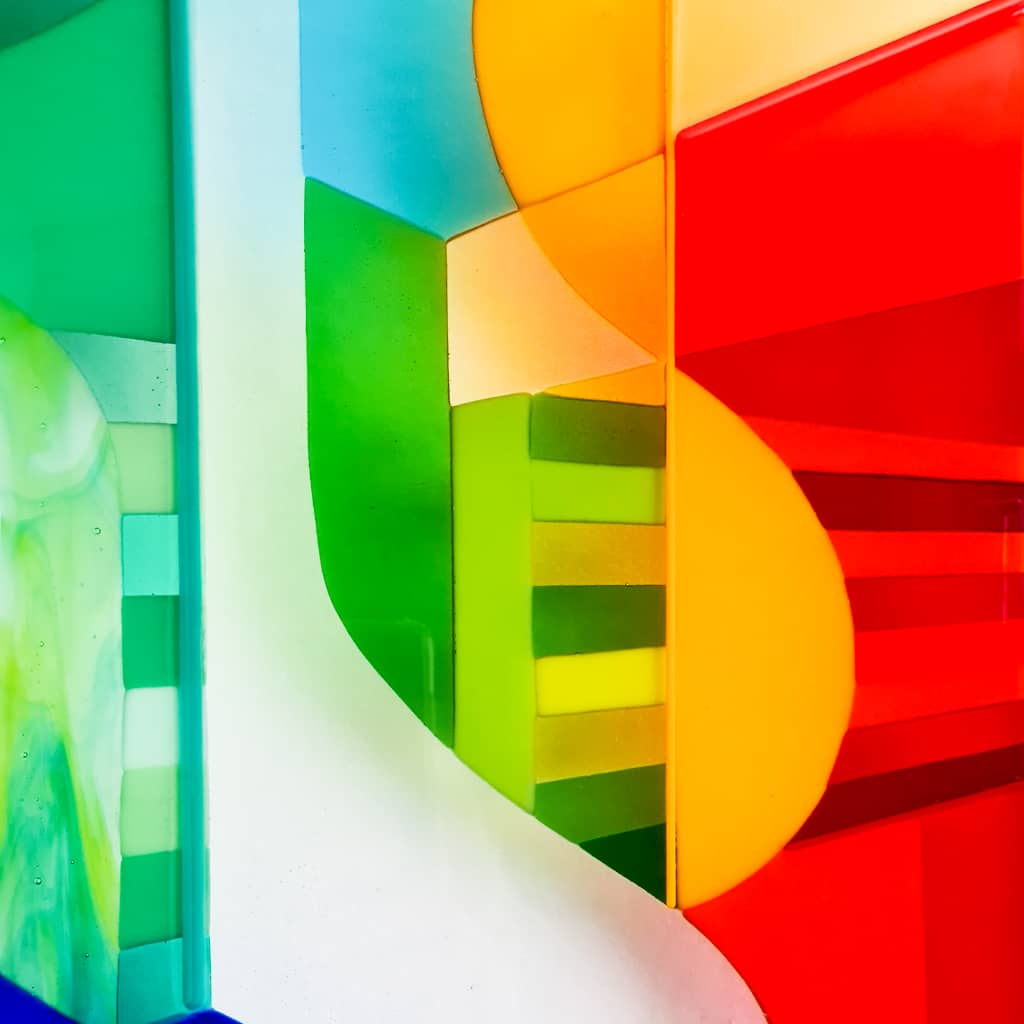


![“Al Held - Pan North IV [1986]” by Gandalf's Gallery, CC BY-NC-SA 2.0](http://glassartbylinda.com/cdn/shop/articles/Al-Held-Pan-North-IV_47076d4a-2b6e-4626-9f40-948178dafb63_1024x1024.jpg?v=1777281131)
You’ve seen this before: “Hard Edge”
You just haven’t had a name for it.
It came from the 60s. A neat label. Californian. Minimal. End of story.
But look a bit more closely and something else appears.
An idea that started much earlier, an idea that ran through many great early abstract artworks, that sharpened into 60s minimalism, then continued, largely unnamed, right up to today.
This isn’t a history of an art movement.
It’s a way of seeing that keeps reappearing, and is growing stronger in a digital age.
A way of seeing, not a moment in time
Look at these three.


Art Institute of Chicago
The world is no longer being described in art. It’s being organised.
Colour separates. Shape defines. Boundaries begin to matter.
With Sonia Delaunay, the edge holds rhythm together.
With Wassily Kandinsky, it appears and dissolves.
With Piet Mondrian, it locks into place.
Nothing is called Hard Edge. Not yet.
But the modern eye recognises it’s already there.
The problem is solved before it is named

Barnett Newman ‘Voice of Fire’
On display at the National Gallery of Canada

Ellsworth Kelly 'Color Panels for a Large Wall' 1978
National Gallery of Art, Washington DC

Frank Stella 'Raqqa II' 1970
The North Carolina Museum of Art
By mid century, the artistic questions have altered, changed, evolved.
It’s no longer about how to organise colour and form.
That’s already been answered, and reputations have been made.
Now the question is how much to commit.
Barnett Newman draws a single dividing line.
Ellsworth Kelly removes everything but shape and colour.
Frank Stella turns the edge into a rule.
No more hesitation. Minimalist form rules.
The 1960s did not invent Hard Edge. They declared it.


Gift of the Gordon F. Hampton Foundation © Al Held Foundation

Los Angeles County Museum of Art © John McLaughlin Estate
By the 1960s, the edge is no longer explored.
It’s accepted. It’s become a usable word for what we see.
Kenneth Noland holds colour precisely inside its boundary.
Al Held builds with it.
John McLaughlin quietens it without softening it.
Critics only needed a name for what they were now seeing.
They called it Hard Edge art.
The name arrives late.
And then something subtle happens

Wexner Center for the Arts at The Ohio State University. Photo by Katie Spengler

NSU Art Museum Fort Lauderdale

Paul-Klee-Platz, Düsseldorf

by Lux & Jourik, CC BY-NC-SA 2.0
The edge does not disappear.
It becomes normal.
Carmen Herrera holds it with calm precision.
Peter Halley turns it into systems.
Sarah Morris maps it onto cities.
Julian Opie reduces people to it.
No one needs the label anymore.
The edge moves into architecture
Sarah Morris, a contemporary English artist, uses the edge for organisation, not decoration. 
Her colour is contained.
Her lines are deliberate.
Nothing bleeds or softens.
But unlike strict minimalists, Sarah’s compositions are dense.
The shapes interlock.
And there’s a sense of movement and tension.
This is where she connects more closely to Sonia Delaunay than many 60s painters do.
Through Order and Rhythm.
The edge goes digital


Something else becomes increasingly significant by the late 20th century.
Not in painting.
In tools.
Vector graphics arrive. Software like Adobe Illustrator becomes standard.
And suddenly every shape has a perfect edge.
Every colour sits flat.
Gradients disappeared (at least early on they do)
Everything is constructed, not brushed.
This isn’t an artistic choice anymore.
Hard Edge has become the default.
What artists once chose, software now enforces.
What this changes
Before the digital age, Hard Edge was a decision.
Afterwards Hard Edge became a condition.
Designers, illustrators, architects, or anyone working digitally, is now operating inside the same visual rules that Piet Mondrian explored, and the 60s painters committed to.
But without calling it anything.
And here, the idea becomes visible again
Looking at Sarah Morris and Linda the same language appears again, expressed differently, using interlocking shapes, controlled colour, clear boundaries, and compositions that feel constructed, even architectural.
We see differences too, Morris is cooler, more analytical, while Linda is more intuitive, more colour-led.
Morris maps systems, while Linda creates experiences of colour, form and light.


Fused glass artwork in rainbow colours in the Hard Edge glass art style


Look closely.
The clarity remains.
The boundary holds the colour.
The shapes interlock with intent.
And something returns from the beginning.
Not just order.
But rhythm.
A quiet echo of Sonia Delaunay, carried through structure refined by Piet Mondrian, declared in the 1960s, and now expressed through light & colour itself.
What you’ve just seen
Hard Edge was never just an art movement.
It was a decision.
To trust the boundary.
To let colour exist cleanly.
To remove doubt from form.
That decision appeared early.
It sharpened over time.
It’s named briefly.
Then it became so natural it’s no longer noticed.
Until you look for it.
And once you see it, you can’t unsee it.
Leave a comment
Hard Edge glass art blog
View all


ABOUT THE AUTHOR
“Hi, I’m Kevin, Linda’s lifelong soulmate. I’m a professional scriptwriter by trade, for which I’ve won many awards.
My mission is to bring Linda’s genius for colour & form into plain words everybody understands and enjoys.”
