





An interview with Linda Rossiter
Most artistic styles have a family tree.
You can trace them back to a movement, a teacher, a famous artist, or a period of experimentation.
Hard Edge Glass is harder to pin down.
When I sat down with Linda to talk about where her style came from, I expected to find a turning point somewhere - a particular influence, a discovery, or perhaps a moment when she suddenly saw a new direction.
Instead, the interview kept pointing somewhere else.
Backwards. Further backwards. Again and again.
The deeper we went, the more it felt as though Hard Edge wasn't invented at all.
It was already there.


"I always drew outlines"
One of the first things Linda said was surprisingly simple.
"I always drew outlines and filled them with colour."
Not occasionally, or during a particular phase.
But always.
Her childhood diaries were packed with detailed drawings.
"Lots of intricate detail. Never a big wash of something."
She remembers using Rotring technical pens with those tiny nibs.
Seen here: Early work - Medical drawing using Rotring pens - by Linda aged 17
Her mother bought them for her even though they weren't cheap - along with many art books.
"I spent years drawing with those pens. Did you know, I still own them?"
She would draw the structure first in ink. Then, fill it with colour.
Listening to her describe it, it becomes difficult not to see the connection with her work today.
The clean divisions, the defined shapes, the absence of any painterly effects.
The foundations were already there.
They just didn't have a name.

The pencil tin
Later in the interview I asked Linda about colour.
Her answer had nothing to do with glass.
Or art school. Or famous painters.
Instead, she started talking about a tin of pencils.
"As a child I was given this huge tin of Caran d'Ache pencils. There must have been 80 or 100 colours in it. It was the most wonderful thing I'd ever seen."
She laughs as she remembers it.
"Nobody was allowed to touch them. I never took them anywhere. I lined them up. I kept them in perfect order. I treated them like gold."
How does commissioning really work?

For a moment she sounds exactly like the young girl she is describing.
But then she says
"I still do it now - with glass"
Yesterday she’d been creating colour palettes for a client, arranging slices of each colour.
The feeling was exactly the same.
"I just love seeing the right colours sitting next to each other."
Then she adds something very 'Linda'.
"I don't like muddy colours. I don't like muted colours. I don't really understand why so much art is beige."
Though anyone who knows her work will already know that :)
The Egg
Many people know that Linda won a National Gallery competition when she was sixteen.
What they may not know is how she approached the painting.
The competition was sponsored by Dulux, a leading paint manufacturer.
Most young artists would have concentrated on painting an egg.

Linda became fascinated by the paint itself.
"I wanted it to look like it had been painted in gloss woodwork paint."
So she experimented. She tested different materials.
She looked for ways to create the crisp, separate shapes, with distinct areas of colour.
Looking at the painting now, it's hard not to see the early fingerprints of Hard Edge.
It doesn’t necessarily look like her current work.
But it thinks like her current work.

Why Fine Art never felt quite right
Linda initially studied Fine Art.
She enjoyed it, but she never felt completely at home there.
"I built huge structures. I taped rocks together in a quarry in the Brecon Beacons. I built, photographed and manipulated all sorts of strange things - in the name of art :)"
"I did some weird and wonderful stuff."
But while all this was happening, she kept looking next door.
"I kept looking at the graphic designers and thinking ‘I want to be on your course.’"
The attraction wasn't fashion. It wasn't career planning.
It was purpose. Graphic design made sense to her.
Even now she talks about visual communication in practical terms.
"Every part of the image has to earn its place."
That sentence appears repeatedly throughout the interview in different forms.
There’s nothing unnecessary, nothing decorative for its own sake.
Everything is there for a reason.

The student room
One story stuck with me after the interview ended.
Most student rooms are full of posters.
Bands. Movies. Heroes.
Someone else's work.
Linda's wasn't.
"My walls were covered with my own work."
Not because she was showing off. But because she genuinely wanted to live with it.
She describes an iconic Anglepoise lamp that became an obsession.
First she drew it in pencil and ink.
Later she painted it in bold acrylics.
Then she recreated it in fabric.
Eventually a giant version covered much of the wall.
"It was what I wanted to wake up and look at every morning."
Many artists spend years searching for a style.
Linda seems to have spent years refining something she already recognised.
The green box
One of my favourite stories has nothing to do with art glass.
At university Linda studied for one of Britain's earliest computer graphics degrees.
This was long before modern software.
Long before anybody carried powerful computers in their pocket.
For one project she spent months programming a wireframe of a cigarette packet.
The box rotated.
That was the project. She laughs.
"It took three months. And it was just a green line. But completely accurate"
No textures. No effects. No realism.
Just a rotating green box. Most people would see limitations of early computers.
Linda just saw the possibilities. And they continued to grow.
"When you've only got eight colours or sixteen colours available, every decision matters."
Listening to her describe those years, it suddenly becomes obvious why Hard Edge developed the way it did.
She learned to simplify, to reduce.
To communicate with less.
The discipline never left her.

The way Linda sees
At one point I asked whether she sees objects or shapes.
Her answer may be the single most revealing moment in the interview.
"I see objects that can be reduced to shapes."
She looks around the room.
Almost immediately she starts analysing it.
A coffee cup. A pen. A table.
"I see the main curve. An oval top. A block of colour. A line for the pen."
The cup disappears - but the structure remains.
"That's the way my brain thinks."
Later she explains that when she begins designing a piece she often removes colour altogether.
"If it's a photograph, I reduce it to black and white first. I don't want colour ideas. I have enough of them :) I want to get the structure."
What's important? Where does the eye go?
What matters in the design?
Only after those questions are answered does she introduce any colour.


The museum and the bus stop
One answer made me laugh. I asked whether other artists influence her.
She paused for a moment, then said something unexpected.
"My influence is me."
Not in an arrogant way - simply as a statement of fact.
She spends far more time studying her own photographs than other people's artwork.
For example, she told me about visiting the Matisse Museum in Nice, France.
Naturally I expected her favourite photograph to be something inside - probably his cutouts. But it wasn't.
"The photograph I liked most was the entrance."
The angles. The curves. The architecture. The strong blue of the signage, and the sky.
Those were the things she remembered.
On another occasion she found inspiration while waiting for a bus near Biarritz.
Not from a painting, or a sculpture, but from the building behind the bus stop.
"There was a whole mess of angles - and in the strong sunlight, some amazing shadows and contrasts. I thought that was extraordinary."
She photographed it, and the image later inspired one of her large roundels.
Again and again throughout the interview, you see the same pattern.
Linda doesn't spend her life hunting for artistic influences.
She spends her life paying attention.

Glass changes everything

For all the clues leading up to this point, glass still changed everything.
"The minute I bought the kiln, I never did copper foil work again."
Not six months later. Not after careful consideration.
Immediately she stopped.
The kiln was a revelation.
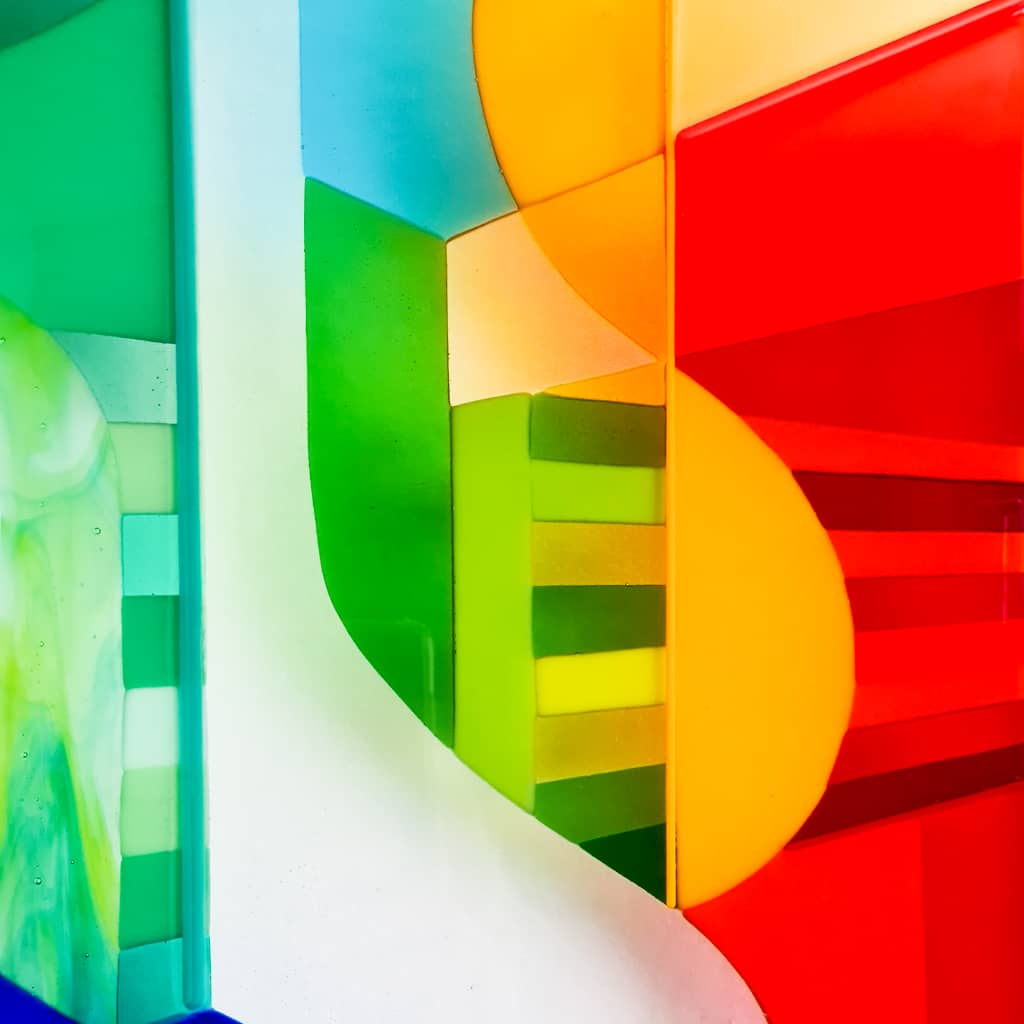
“Artists have always studied the effect of different colours next to each other. Always having a black line between them is very restrictive. Finally I could get rid of it”
For the first time she could place pieces of colour directly against one another without black lines interrupting them.

Then came light.
"The addition of glass added light in a way I'd never seen before."
She describes holding a dark green piece of glass.
Against the table it looks almost black. Then she lifts it to a window - suddenly it glows.
"The light adds a whole new level."
Even after years of working with glass, the excitement is still present in her voice.

Precision
People often assume the magic is in the colour.
Linda doesn't.
She believes much of it lies in precision.
"The two pieces have got to touch."
She is talking about glass. But she could almost be talking about her entire philosophy.
No shortcuts. No gaps. No compromises.
"The minute I start saying 'that'll do', it's time to stop and walk away."
There is probably more truth in that sentence than in pages of artistic theory.
Looking Back
Near the end of our conversation I asked Linda whether she created Hard Edge or whether Hard Edge created her.
"I created Hard Edge."
Then she paused - and traced a clear line through her life:
Technical drawing.
Scientific illustration.
Exploded engine diagrams.
Graphic design.
Vector graphics.
Glass.
Looking back, she can see the progression clearly.
"There's a natural progression from six to sixty."

Perhaps that's the answer. Hard Edge didn't arrive suddenly.
It wasn't copied, or borrowed.
It wasn't fashionable.
The child with the Rotring pens.
The teenager painting a fried egg.
The student whose walls were covered with her own work.
The designer spending three months making a wireframe box rotate.
The artist photographing buildings from bus stops.
All of them were already travelling in the same direction.
What actually changed over the years wasn't the way Linda saw the world.
She simply found better and better ways to show it to the rest of us.