





A city at its best
Once upon a time, back in 1860, when Liverpool stood as the second city of the global British Empire, its wealthy civic leaders decided to build a park that would match the city’s ambition and world reach.
Not a simple stretch of lawn or a polite municipal garden, but a sweeping landscaped vision, romantic in spirit and generous in scale, designed to rival the great public parks of Europe.
They called it Sefton Park, named after the local gentry family, the Seftons.

And at its heart, raised slightly above the surrounding land so that it could be seen from different approaches, they built a structure that became its defining emblem: a crown of iron ribs and curved glazing to shimmer before the northern sky.
The Sefton Park Palm House.
Palm houses in the nineteenth century were never just greenhouses. They were public statements of engineering confidence and imperial connection, gathering tropical plants from distant climates.


The Palm House at Kew Gardens, London showing "descriptions and figures of the rarest and most deserving plants, newly introduced on the continent or in England"
And the British iron and glass industries created beauty. Structure met spectacle. Architecture framed nature rather than hiding behind it.
The Palm House was, above all, architecture first. The plants came second. Or at least at first.

The Palm House rising as the architectural crown of the park. Sefton Park Palm House.
A rare subject in art
For buildings so extraordinary in scale and ambition, palm houses are surprisingly rare in painting.
Artists were often captivated by the interiors, by the foliage and humidity and the figures wandering among exotic leaves. The botanical spectacle drew attention away from the structure that made it possible.

There are paintings of the Crystal Palace, and a handful of exterior views of the Palm House, Schönbrunn or the Palm House, Kew Gardens, yet serious artistic treatments of the palm house as monumental exterior architecture remain scarce.

The iron ribs, or the repeating bays, or the great dome cutting into the open sky - all of it. These elements, bold and geometric, offered a powerful subject that few artists fully explored. The palm house as an architectural declaration was largely left alone.
That absence left a space.
And it’s precisely within that space that Linda’s Palm House finds its voice.
Research. Immersion. Translation.
Before a single piece of coloured glass was cut, there was patient observation.

Linda visited the Palm House at Sefton Park repeatedly, walking its perimeter, studying how the structure sits in the landscape and how its silhouette changes with shifting light.
She photographed not simply the plants, but the geometry.

The rise of the dome.
The shape of the iron ribs.
The measured spacing of the glazed panels.
What interested her most was not so much the tropical foliage within, but the disciplined framework that holds everything together.
How do you translate iron and glass into fused glass, without becoming a grey & white dull object that fails the imagination?
Having researched and studied for other architectural pieces such as 'Stairs' she knew that representing the form wasn't enough - colour was so important too.
How do you capture pragmatic structure without losing the essential power and vitality you see whenever you actually look at it?

The answer was never going to be a literal copy.
It required interpretation, distillation and, ultimately, reconstruction through colour.
But it would be a perfect example of her Hard Edge glass art style.
From Victorian architecture to 320 pieces of glass
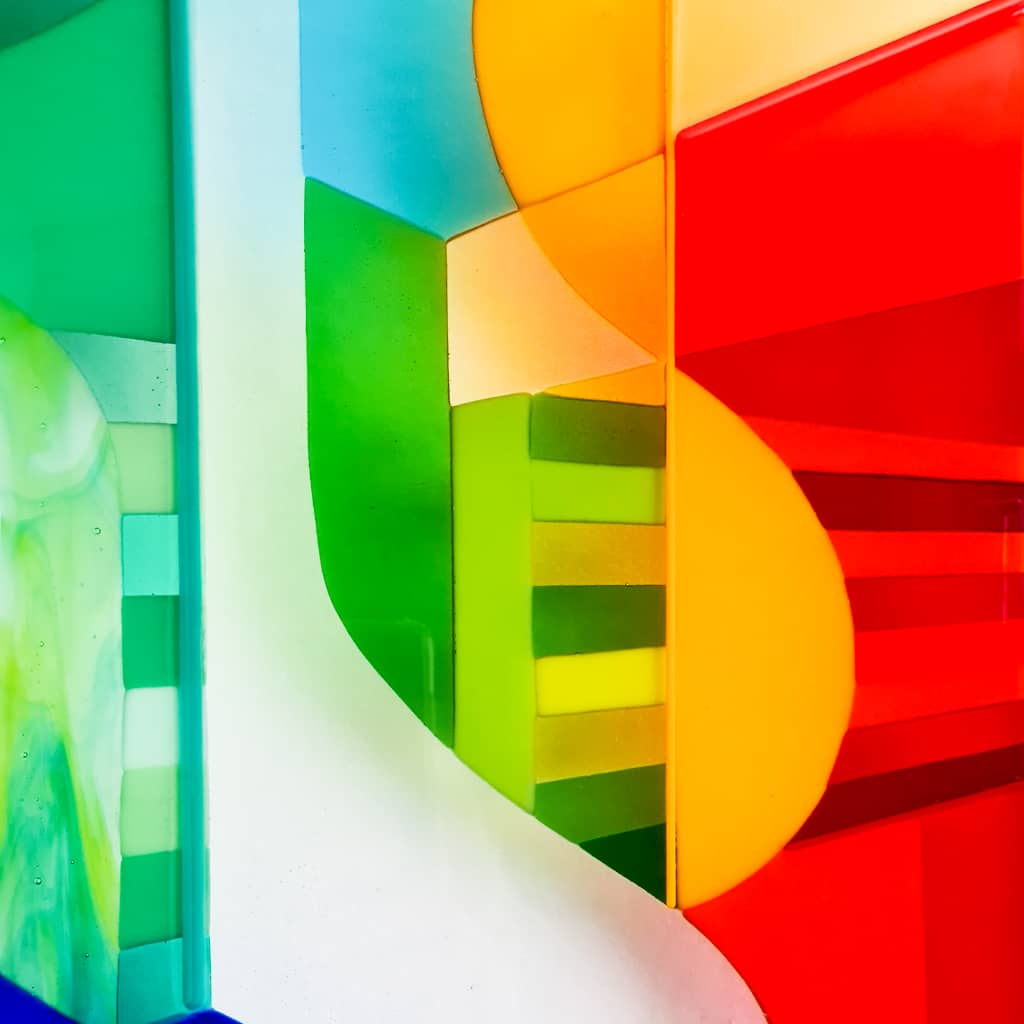
‘Palm House’ became the most complex fused glass panel Linda had created to date in a single panel, composed of over 320 individually cut shapes.

Each piece was selected for tonal value and its effect on the overall composition which broadly breaks down into 4 major parts.

Colours were tested against one another.
Edges were refined.
Pieces were recut where the rhythm felt wrong.
What emerged was not decorative layering, but architectural construction in miniature.
The iron ribs of the original building became disciplined bands of neutral colour. The glazing transformed into subtle, yet quite varied tonal shifts.
The dome emerged not as an outline, but as a cascade of light held in tension by structure.
Finally, the kiln fused every component piece into a single unified surface.

What began as hundreds of separate decisions became one coherent body of glass.
The Victorian engineers worked with rivets and girders.
Linda worked with colour and fire.
A Cascade of Colour
The finished work is not botanical illustration, nor is it a nostalgic tribute.
It’s a cascade of colour contained within a fierce geometry.

From a distance, the silhouette reads clearly. The dome rises. The ribs repeat with measured rhythm. The composition feels architectural and assured.
Closer inspection reveals the complexity beneath that calm surface. Hundreds of unique pieces, all different to one another, each add to a larger unity, creating a tension between geometric order and organic vitality that mirrors the spirit of the original building.

Serious contemporary fused glass studies of historic palm house exteriors are, to our knowledge, almost non-existent.
In choosing to treat the Palm House as monumental architecture rather than, say, an artistic display of the stunning interior foliage, this work steps into territory that has rarely been claimed.
From empire to contemporary glass
When the Sefton Park Palm House was completed, it symbolised civic pride and global connection. It declared that Liverpool could build in iron & glass with as much confidence as any city in the world.
More than a century later, that same structure has been reimagined through colour and Hard Edge fused glass, not as nostalgia, but as striking contemporary architectural art.
Victorian ambition once built a monument in iron and glass.
Linda’s Palm House rebuilds it in light.
And in doing so, it tells a story that spans centuries, materials and meanings, while effortlessly claiming something new.

Researching at Sefton Park Palm House
Leave a comment
Hard Edge glass art blog
View all


ABOUT THE AUTHOR
“Hi, I’m Kevin, Linda’s lifelong soulmate. I’m a professional scriptwriter by trade, for which I’ve won many awards.
My mission is to bring Linda’s genius for colour & form into plain words everybody understands and enjoys.”
