





Most people instinctively know when a room feels good.
They walk in and feel calmer.
Or more awake.
Or somehow more at ease.
What’s less common is stopping to ask why.
Almost every interior has a silent, unspoken sentence attached to it.
A small “but…” that lingers in the background.
“It’s nice, but a bit flat.”
“Relaxing, but slightly dull.”
“Clean, but cold.”
Nothing is wrong with the space. It functions. It looks fine.
Yet something is missing, and you feel it, even if you can’t name it.
That feeling is where colour does its real work.
Colour and psychology (no theory required)
You don’t need to know colour theory to be affected by colour. You’re already responding to it all day long.
Warm colours tend to feel closer, more human, more intimate.
Cool colours often feel calmer, more distant, sometimes more cerebral.
Highly saturated colour brings energy and intensity.
Restrained colour brings quiet and control.
This isn’t academic. It’s lived experience.
Think of the difference between a café wall painted in soft, chalky neutrals versus one with a deep amber wall behind the counter.
Or the way a pale blue bedroom can feel serene during the day, yet slightly lonely at night.


Colour changes how we inhabit a space-not intellectually, but emotionally.
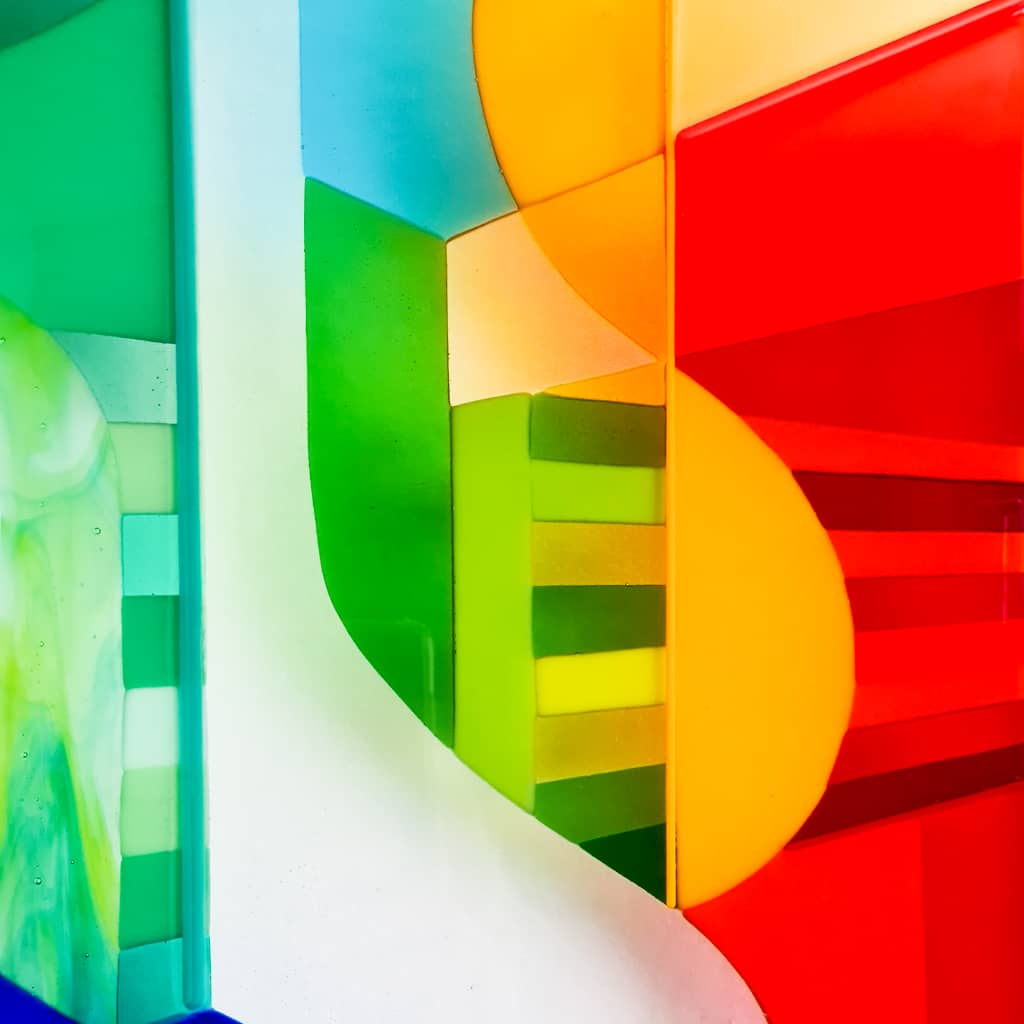
Glass takes this one step further, because colour in glass isn’t just seen.
It’s carried by light.
Light passes through it.
Moves with the time of day.
Shifts with the weather.
Colour becomes active rather than static.

What a small colour change can actually do
Imagine a neutral living room: pale walls, natural textures, well chosen furniture. Calm. Tasteful. And somehow lifeless.
Nothing calls to you. Nothing holds you.
Now imagine introducing a single decisive element of colour in glass, say a deep, resonant blue or a warm, earthy red, placed where light naturally passes through the room.
Suddenly the space has a centre of gravity. Not louder. Deeper.

Or take the opposite situation: a bright, energetic room that feels scattered. Lots of colour, lots of stimulation, nowhere to rest.
Introducing structure - through geometric form and disciplined colour choice - can calm the space without draining it of life.

The same glass piece can even behave differently across the day.
In morning light, colour might feel fresh and optimistic.
In evening light, richer and more reflective.
The room hasn’t changed. You haven’t changed.
But the emotional tone has shifted.
That quiet responsiveness is something painted surfaces simply can’t do.

Not decoration. Emotional tuning
This is where Hard Edge glass finds its place.
Not as ornament. Not as an afterthought.
But as a way of tuning a space emotionally.
Instead of redecorating everything, you address the room’s unspoken “but…”.
“It’s calm, but it needs warmth.”
“It’s impressive, but it feels distant.”
“It works, but it doesn’t quite feel like me.”
A small intervention - precise colour, considered form, intentional placement - can have a disproportionate effect.
The space doesn’t look “done”. It looks right.
And importantly, it doesn’t announce how it works.

Quiet depth and self-recognition
The best spaces don’t explain themselves. They don’t shout about design decisions. They simply make you feel slightly more yourself when you’re in them.
That’s not accidental. It’s the result of someone understanding how colour, light, and restraint interact - and knowing when to stop.
There’s a kind of generosity in that. An assumption that the person living with the work doesn’t need to be impressed, instructed, or overwhelmed. Just met, quietly, where they already are.
In that sense, choosing work like this isn’t about luxury or display.
It’s about giving yourself permission to live with something that genuinely resonates.
Something you don’t have to justify.
Something that acknowledges - without saying so out loud - that you deserve a space which supports how you feel, not just how things look.
And when colour is handled with this level of care, that support happens almost invisibly.
You just notice, one day, that the room no longer has a “but…”.
It simply feels complete.
Leave a comment
Hard Edge glass art blog
View all


ABOUT THE AUTHOR
“Hi, I’m Kevin, Linda’s lifelong soulmate. I’m a professional scriptwriter by trade, for which I’ve won many awards.
My mission is to bring Linda’s genius for colour & form into plain words everybody understands and enjoys.”
