





For a long time glass lived in an awkward place in the art world.
Everyone recognised its beauty.
Few people thought of it as serious art.

You saw glass in cathedrals, in decorative bowls, in architecture. You admired it.
You might even collect a vase as an object.

But it rarely entered the same conversation as painting or sculpture.
That perception is changing. Not because glass suddenly became interesting. It always was.
What changed is the technology and the opportunity for a new generation of artists trained in glass.

Today contemporary glass art is entering a new phase.
Many collectors are watching it closely, watching artists explore new ways in light, colour and geometry.
Some have already begun to buy.
A medium that finally caught up with its potential
Glass has always been capable of extraordinary visual effects.
Colour suspended in light has a presence that paint can never quite reproduce.
But historically there were practical barriers.
Glass studios required large industrial equipment. Kilns were enormous and expensive. Colour choices were limited. Precise cutting tools were hard to find. And producing consistent colours in multiple shades was difficult.

That has all changed dramatically over the last few decades.
Smaller, powerful-yet-affordable kilns now allow artists to fire complex pieces in a studio environment rather than a factory.
Precision diamond saws and ring saws, and other cutting tools like water-cooled grinders help make intricate organic shapes achievable.

And specialist manufacturers now produce art glass in a good range of colours and densities.
For the first time, artists can treat glass as a serious compositional medium, not just a decorative material.
Glass has finally caught up with its artistic potential.

Glass does something paint cannot
When you look at a painting, you see colour reflected from a surface, literally bounced off.
Glass works differently.
Light passes through it, as well as reflects. It does both.
This simple difference changes everything.
Colour in glass feels luminous because it’s literally carrying zillions of photons of light inside it.

The colours appear deeper, more saturated, more alive than coloured paste on a board.
Move the piece, or change the light in the room, and the experience shifts subtly, sometimes wonderfully dramatically.
The artwork becomes a collaboration between material and light, infused with the artist’s human spirit in the way it handles light, while creating that wonderful illusion we call Beauty.
These qualities of glass, light, and the human story it tells, have fascinated artists for centuries.
The makers of stained glass windows in a medieval cathedral already understood this relationship.

Those artists were not simply filling windows with colour.
They were shaping light itself to tell a story, portraying a deep feeling, and exalting the spaces in which they were seen.
Modern studio glass artists are now continuing this exploration in a completely different context.
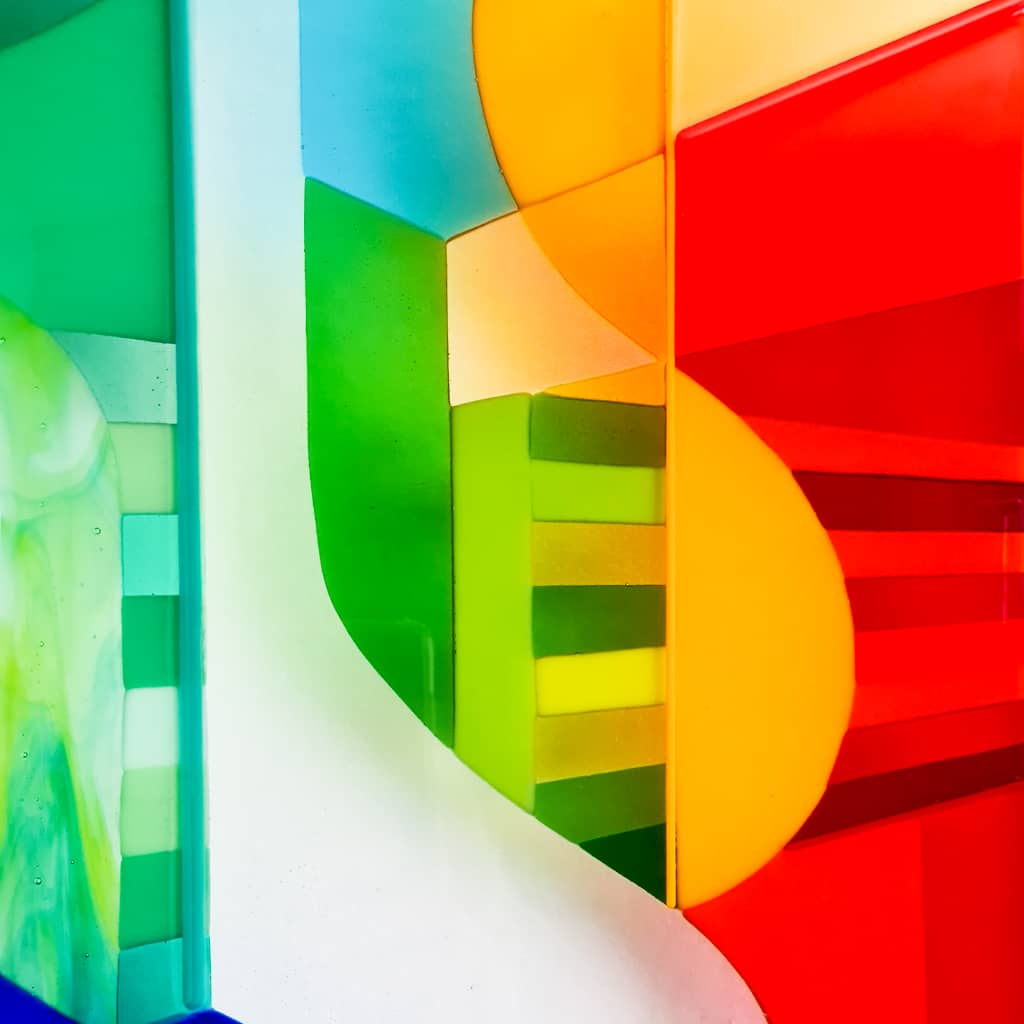
By using extraordinary new techniques to achieve their vision - such as Hard Edge glass and other contemporary forms of fusing - a once-traditional field of art is being dramatically redefined.
Why geometry works so well in glass
Contemporary glass artists are drawn to geometric abstraction, often called Hard Edge art.
The reason is simple.
Glass loves clarity.
Hard Edge art removes visual noise, such as the clumpy lead metal runnels (called “cames”) that hold stained glass windows in place.

The Hard Edge style relies on clean lines, strong colour fields and precise relationships between shapes. The style became famous in canvas painting through artists like Ellsworth Kelly and Frank Stella.

It actually started even earlier with Mondrian, who isn’t labelled Hard Edge, but is still unmistakably so.

Mondrian was in fact the first modern Hard Edge artist before any of them.
Hard Edge glass art today takes all these ideas to an entirely new and often bewitching level.
Edges become physical joins between pieces of colour.
Light travels through each shape differently.
A red panel might glow while a blue panel becomes deep and mysterious.
Geometry becomes light sculpture in a flat art form.
And because the shapes must be cut with great precision, the craftsmanship behind the work becomes an intrinsic component of the artistic achievement.
Glass shapes are not always so easy to pull off, in the way Linda’s videos make them look.
Execution is often tricky and, in its way, quite comparable to the exquisite brush handling seen in the best canvas-style painting.
The importance of light
Another change is happening in how glass art is displayed.
Traditionally glass panels were mounted on walls, or windows, almost like paintings.
But glass doesn’t always look its best there.
Wall mounting restricts the light passing through the work.
You only see reflected colour, not transmitted colour.

So wall hanging needs serious consideration, such as stand-off mounts which lift the work out away from the wall to let the light in, and maybe some lighting to bring out its best at night.
This is why many contemporary artists often prefer freestanding displays as they allow light to move through the glass from multiple directions.
One approach is the use of roundels displayed on stands, a display concept pioneered by Linda.
The circular (or oblong) format allows colour and geometry to sit naturally within the form, while the stand lets the piece interact with the room around it.

As light moves across the space during the day, so the artwork changes with it.
Instead of being fixed on a wall, it becomes part of the living environment. This is such a good feeling, as any glass art collector will tell you.
And they’ll also tell you they have the freedom to move the piece around, maybe from a desk to a window ledge, or go from room to room.
There’s no law in glass art that says a piece always has to live in the same place.
You have choices. Wonderful.
A medium having its moment
Art moves in cycles.
Materials rise and fall in the attention they get from collectors, artists and the art-loving public.
Today glass sits at an interesting point.
The technical possibilities have expanded enormously since this wiki article was written on Studio Glass.
Artists are exploring ideas that were once not just impractical, but impossible.
Architects are integrating glass art into interiors, with architectural glassworks such as lobby sculptures and public installations.

Blown glass artists like Dale Chihuly fetch £200,000 for larger installations.
And collectors who already appreciate colour and abstraction are noticing the medium more closely.
You can feel the curiosity growing.
Some collectors are watching very carefully, “circling” as it’s called in art circles.
Others are taking their first tentative steps into collecting glass.
Either way you look at it, something is happening.

Glass has moved beyond decoration. It’s becoming recognised for what it always had the potential to be:
A powerful artistic medium where colour, geometry and light come together in ways no other material can quite match.
And in the right hands, the results can be extraordinary. It’ll be even more interesting to see where contemporary glass art goes next.
Curious to see the latest Hard Edge geometry works in glass? Explore recent works in Linda’s commissions gallery.
Leave a comment
Hard Edge glass art blog
View all


ABOUT THE AUTHOR
“Hi, I’m Kevin, Linda’s lifelong soulmate. I’m a professional scriptwriter by trade, for which I’ve won many awards.
My mission is to bring Linda’s genius for colour & form into plain words everybody understands and enjoys.”
